USAID DEC
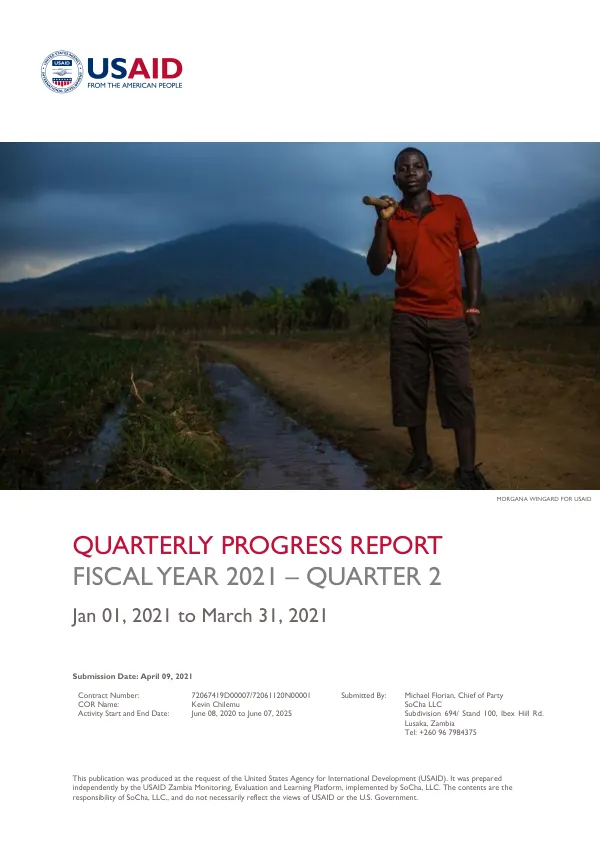
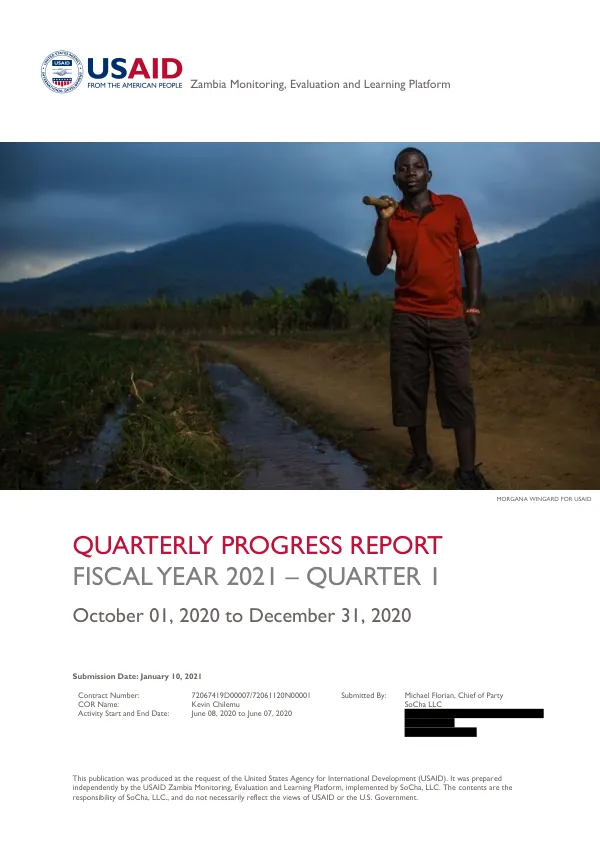
Quarterly Progress Report: Zambia Monitoring, Evaluation and Learning Platform (Z-MELP) FY21 Q1
Sign inSOCHA, LLC
Quarterly Progress Report: Zambia Monitoring, Evaluation and Learning Platform (Z-MELP) FY21 Q1
The USAID/Zambia Monitoring, Evaluation and Learning Platform (Z-MELP) Activity began work on June 8, 2020, and will continue until June 7, 2025.
2021 · 30 pages
Sign in to readA free account is required to download.
Abstract
It is implemented by SoCha LLC. The purpose of Z-MELP is to improve program performance management and efficiency at all levels, to help the Mission meet Agency requirements, make improved informed strategic and management decisions around program implementation, and advance Agency learning. Z-MELP provides technical assistance across the Mission's Program Cycle management-related tasks, including performance monitoring support, evaluation support services, data management support, capacity building and strengthening services, and collaborating, learning and adapting (CLA) support services. The tasks under each objective are differentiated into two types: core tasks, which relate to standard work requests and are expected to be delivered in each year, and tasks that draw on program activities funds, which must be specifically activated and draw on a dedicated pool of funds. The Z-MELP Assistance Menu includes core tasks and tasks that draw on program activities funds. Core tasks include performance monitoring support, evaluation support services, data management support, capacity building and strengthening services, and CLA support services. Tasks that draw on program activities funds include tasks such as third-party monitoring, evaluation management and analysis, and customized information products. As of the reporting period, October 1, 2020, to December 31, 2020, Z-MELP has completed several work requests, including a review of the ZPPLA midterm performance evaluation, a review of the Youth Lead Learning Strategy, and a one-pager on "How-to-Access Z-MELP." The satisfaction of requesters for completed work requests is generally high, with most requests receiving positive feedback. During the reporting period, Z-MELP received a total of 24 work requests, with 8 requests in the performance monitoring support objective, 9 requests in the evaluation support services objective, 3 requests in the data management support objective, and 4 requests in the capacity building and strengthening services objective. The majority of work requests are in the process of being executed or are in design. The Z-MELP Activity is structured around several service tasks within each support area that the Mission can adaptively draw upon as demand arises. As such, the tasks function as a menu of services that ensure Z-MELP operates as a flexible and demand-driven support mechanism to the USAID/Zambia Mission.
Related documents