FHI 360
Zambia HIV/AIDS Prevention, Care and Treatment (ZPCT) Partnership
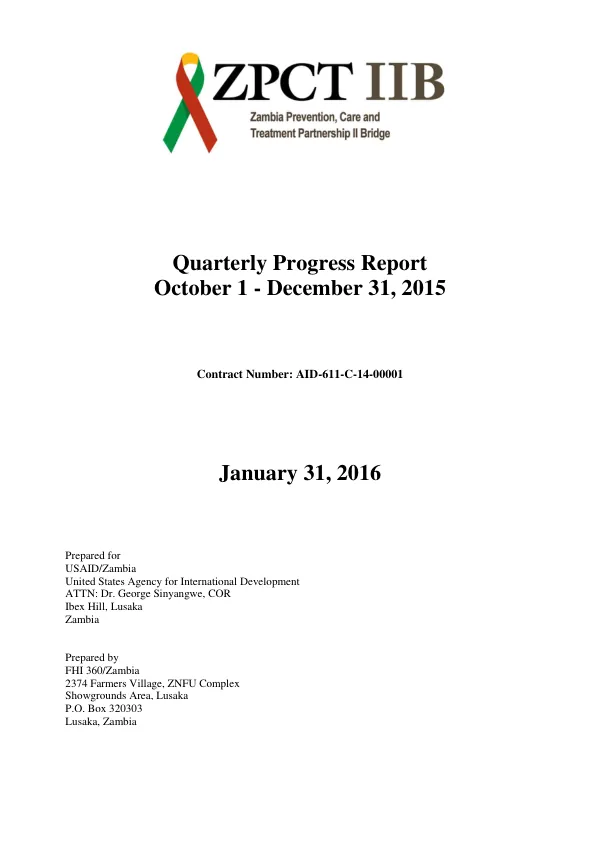
The Zambia Prevention, Care and Treatment Partnership II Bridge (ZPCT IIB) is a 14-month contract between FHI 360 and the U.S.
2015 · 60 pages
Sign in to readA free account is required to download.
Abstract
Agency for International Development (USAID) through the U.S. President's Emergency Plan for AIDS Relief (PEPFAR) with a ceiling of US $24,900,000. The project aims to strengthen and expand HIV/AIDS clinical and prevention services in six provinces: Central, Copperbelt, Luapula, Muchinga, Northern, and North-Western. ZPCT IIB supports the Government of the Republic of Zambia (GRZ) goals of reducing prevalence rates and providing antiretroviral therapy (ART). The project implements technical, program, and management strategies to initiate, improve, and scale-up elimination of mother-to-child transmission (eMTCT); HIV testing and counseling (HTC); expansion of male circumcision services; and clinical care services, including ART. The objectives of the ZPCT IIB project are to maintain existing HIV/AIDS services and scale-up the program to meet PEPFAR targets, maintain the partnership and involvement of multiple stakeholders to sustain comprehensive HIV/AIDS services, and encourage integration of health and HIV services. Task 1 focuses on maintaining existing HIV/AIDS services and scaling up the program to meet PEPFAR targets. This includes HIV testing and counseling (HTC) services, elimination of mother-to-child transmission (eMTCT) services, antiretroviral therapy (ART), clinical palliative care services, scale-up of Voluntary Medical Male Circumcision (VMMC) services, TB/HIV services, and the Population Effects of Antiretroviral Therapy to Reduce HIV Transmission (PopART) Study – HPTN071. Task 2 aims to increase the partnership and involvement of multiple stakeholders to sustain comprehensive HIV/AIDS services. This includes maintaining, expanding, and strengthening pharmacy services, laboratory services, and the capacity of facility health care workers and community volunteers. The project also supports community volunteers, community-based organizations (CBOs) and faith-based organizations (FBOs), and the Government of the Republic of Zambia (GRZ) community structures to increase HIV/AIDS service demand and support people living with HIV/AIDS (PLHIV) self-care, retention in care, and ART adherence. Task 3 focuses on increasing the capacity of the Provincial Medical Offices (PMOs) and District Community Medical Offices (DCMOs) to perform technical and program management functions. This includes a joint assessment and planning process and provision of capacity strengthening technical assistance and related support. The project has made significant progress in the quarter, with major accomplishments including the initiation of eMTCT services in all six provinces, the expansion of HTC services to reach 90% of the target population, and the scale-up of VMMC services to reach 80% of the target population. The project has also strengthened the capacity of facility health care workers and community volunteers, and supported the integration of health and HIV services. The project has also faced several challenges, including delays in the procurement of equipment and supplies, and the need for additional technical assistance to support the scale-up of eMTCT services. However, the project remains on track to meet its objectives and is making significant progress in reducing HIV prevalence rates and providing antiretroviral therapy (ART) to those in need.