AED
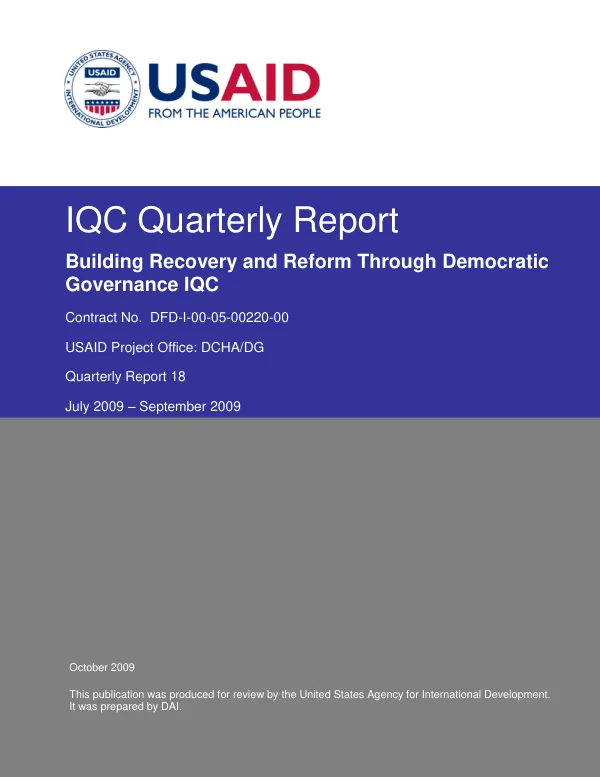
Quarterly Report 18: Building Recovery and Reform Through Democratic Governance IQC
The Building Recovery and Reform through Democratic Governance IQC is a USAID-funded project that aims to support democratic governance in several countries.
2009 · 19 pages
Sign in to readA free account is required to download.
Abstract
The project is managed by DAI and has been in operation since 2005. The project has undergone several modifications, with the most recent one being issued on September 30, 2009. The project has six task orders, each with its own objectives and scope. Task Order No. 1, Building Recovery and Democratic Governance to Advance and Consolidate the DRC Transition Program, has been completed with 100% percent completion. Task Order No. 2, USAID Technical Support Project for Social Investment and Capacity Building in Equatorial Guinea, has a 97.4% completion rate and is expected to be completed by December 2010. Task Order No. 3, Building Recovery and Reform through Democratic Governance in Liberia, has also been completed with 100% completion. Task Order No. 4, Promoting Accountability, Transparency, and Integrity in Bangladesh, has a 50% completion rate. Task Order No. 5, F- Capacity Building Program in Pakistan, has a 58.33% completion rate and has undergone several modifications, including a budget increase to $45,536,298. Task Order No. 6, Building Recovery and Democratic Governance to Advance and Consolidate the DRC Transition Program, has a 64% completion rate and has undergone several modifications, including a project end date extension and a contract ceiling increase to $9,349,015. Task Order No. 7, USAID Proyecto de Justicia in the Dominican Republic, has a 38.9% completion rate and has undergone several modifications, including a budget increase to $3,151,000. Task Order No. 8, Kosovo Ministry of Foreign Affairs Support Project, has a 20% completion rate and has undergone several modifications, including a ceiling and obligation amount increase. The Technical Support for Social Investment and Capacity Building in Equatorial Guinea project has made significant progress during the quarter, including the development of checklists for procedures to follow at various stages of the social infrastructure process. The project has also developed a tool for the categorization of various types of projects and prepared an agenda and training for a workshop on the infrastructure process. Additionally, the project has provided guidance and instruction to the Ministry of Education, Science and Technology and the Ministry of Health and Social Welfare on the financial regularization of their projects. The project has also strengthened and expanded the Primary Health Care Project, which includes monitoring and evaluation activities, the construction of health centers, and new activities as part of a first-year strategy. The budget for the project has been revised to include the new activities.