FINTRAC
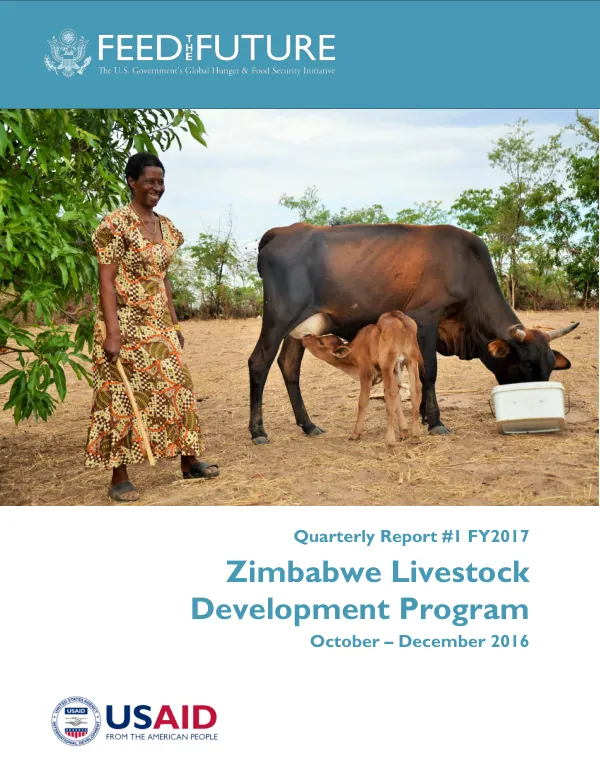
Quarterly Report #1 FY2017: Feed the Future Zimbabwe Livestock Development Program
The Feed the Future Zimbabwe Livestock Development Program is a market-driven initiative aimed at reducing rural poverty and improving household food security, incomes, and nutritional status among beef and dairy smallholder producers.
2017 · 77 pages
Sign in to readA free account is required to download.
Abstract
The program began on June 23, 2015, and runs through June 22, 2020, with a focus on agro-ecological regions III, IV, and V. Activities are confined to low-income and food-insecure households with the potential to move from subsistence to small-scale commercial farmers. The program's primary objectives include increasing production, productivity, and market linkages for smallholder beef and dairy farmers. Commercialization of small-scale beef and dairy farmers on communal and non-contested land is being achieved through various interventions. These include raising efficiencies in beef and dairy production systems, facilitating access to inputs, technology, finance, and credit, linking producers to local, national, regional, and international buyers, and training farmers to adopt good agricultural, business, and animal husbandry practices. Training farmers to adopt good nutrition and hygiene practices is also a key component of the program. The Feed the Future Zimbabwe Livestock Development program collaborates with the Feed the Future Zimbabwe Crop Development program and other donor programs to provide specialized technical support to produce nutritious crops that sustainably increase the availability of these foods among beneficiary households. Local nongovernmental organizations and commercial companies work with the program as development partners, co-funding purchases of essential inputs and new technologies for demonstration purposes on a cost-recovery basis. The program is implemented in partnership with subcontractor ABS-TCM and other local private companies, non-governmental organizations (NGOs), the Division of Livestock Production and Development, the Department of Veterinary Services, and other government departments involved in the beef and dairy value chains. The Feed the Future Zimbabwe Livestock Development program directly contributes to food availability and access by concurrently increasing production and raising income levels among smallholder farmers. Key activities implemented during the first quarter of the program include beneficiary identification and registration, farmer training on good agricultural practices, and provision of inputs and technology to participating farmers. The program also established a client impact and results information system (CIRIS) to track progress and monitor the impact of the program on beneficiary households. The CIRIS system enables the program to identify areas of improvement and make data-driven decisions to optimize program implementation. The program's gender mainstreaming strategy aims to empower women and girls through training and capacity building. Women's groups are established to promote women's participation in decision-making and leadership positions. The program also provides training on good nutrition and hygiene practices, with a focus on women and children. The goal is to improve the nutritional status of beneficiary households and reduce the prevalence of malnutrition among children under the age of five. The Feed the Future Zimbabwe Livestock Development program has made significant progress in its first quarter of implementation. The program has established a strong partnership with local stakeholders, including NGOs, private companies, and government departments. The program has also made significant strides in training farmers on good agricultural practices, providing inputs and technology, and establishing a client impact and results information system to track progress.