USAID
Quarterly Report 30 (October 2021 – December 2021)
The Nexos Locales project, a USAID-funded initiative, entered its eighth year of implementation in Q30, spanning from October 1, 2021 to December 31, 2021.
2021 · 2 pages
Sign in to readA free account is required to download.
Abstract
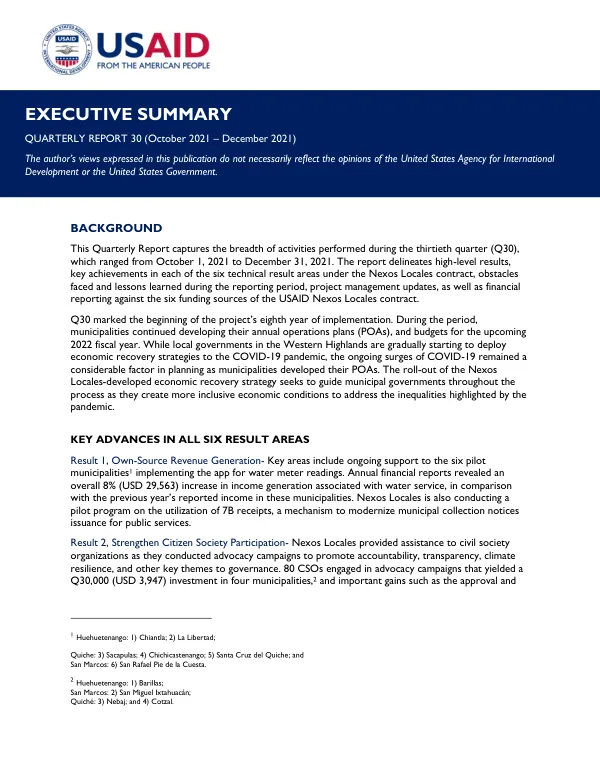
Municipalities in the Western Highlands continued to develop their annual operations plans (POAs) and budgets for the 2022 fiscal year, while navigating the ongoing COVID-19 pandemic. The project's economic recovery strategy aimed to guide municipal governments in creating more inclusive economic conditions to address the inequalities highlighted by the pandemic. Result 1, Own-Source Revenue Generation, saw significant progress, with ongoing support to six pilot municipalities implementing the app for water meter readings. Annual financial reports revealed an overall 8% increase in income generation associated with water service, totaling USD 29,563. Nexos Locales also conducted a pilot program on the utilization of 7B receipts, a mechanism to modernize municipal collection notices issuance for public services. Result 2, Strengthen Citizen Society Participation, involved Nexos Locales providing assistance to civil society organizations as they conducted advocacy campaigns to promote accountability, transparency, climate resilience, and other key themes to governance. A total of 80 CSOs engaged in advocacy campaigns, yielding a Q30,000 (USD 3,947) investment in four municipalities. Important gains included the approval and launch of a municipal policy on food security and nutrition in the Tacaná and Sibinal municipalities. Result 3, Increase Access to Potable Water, focused on Nexos Locales working with the Municipal Water and Sanitation Offices (OMAS) on topics related to water quality, infrastructure maintenance, and annual programming. Water campaigns stemming from the project-developed Water Investment Plans were concluded in three municipalities, consisting of structural upgrades and repairs in water distribution systems and water treatment plants. Local governments in these municipalities allocated a total budget of Q19,000 (USD 2,500) to complete these water infrastructure campaigns, aiming to ensure safe and sustained water delivery services to 6,780 water users. Result 4 and Result 5, Local Economic Development and Adaptation to Climate Change, involved the project providing technical assistance to various municipal offices to develop project profiles that aim to increase economic opportunity for vulnerable groups. As a result, 13 municipalities allocated Q2,851,750 (USD 375,230) for the implementation of 20 women-centered projects, and 11 economic growth initiatives were approved in seven municipalities, totaling Q1,763,860 (USD 232,086).
Related documents