USAID
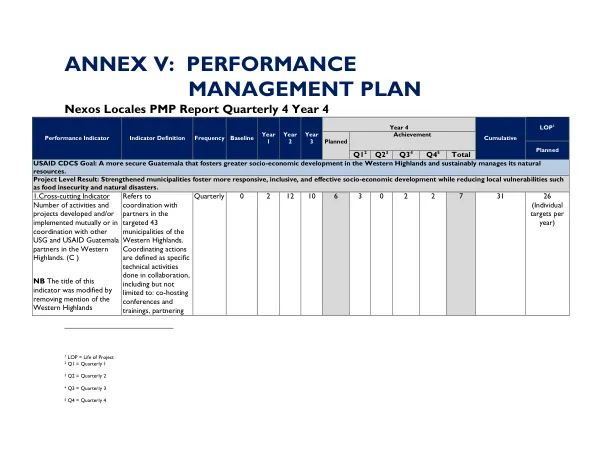
Nexos Locales PMP Report Quarterly 4 Year 4
The USAID-funded project in Guatemala aims to strengthen municipalities in the Western Highlands, promoting socio-economic development and sustainable natural resource management.
2018 · 36 pages
Sign in to readA free account is required to download.
Abstract
The project's primary goal is to foster more responsive, inclusive, and effective socio-economic development while reducing local vulnerabilities such as food insecurity and natural disasters. To achieve this objective, the project focuses on several key areas. One of the main performance indicators is the number of activities and projects developed and/or implemented in coordination with other USG and USAID Guatemala partners in the Western Highlands. This indicator measures the project's ability to coordinate with partners in the targeted 43 municipalities of the Western Highlands. As of the fourth quarter of the project's fourth year, a total of 31 activities and projects have been developed and/or implemented. Another key performance indicator is the number of USG-supported activities designed to promote or strengthen the civic participation of women. These activities include trainings in advocacy, participatory budgeting, and watchdog/accountability practices that incentivize women to participate in local governance. As of the fourth quarter of the project's fourth year, a total of 40 activities have been counted, with 38 of them being exclusively for women or containing a discreet module that promotes women's participation. The project also aims to support youth development activities, including programs, partnerships, policy reform, institutional strengthening, grant making, and research and evaluation that actively and constructively involve and support young people. As of the fourth quarter of the project's fourth year, a total of 1208 youth have participated in USG-supported activities, with 1000 of them assuming leadership roles within their communities. The project has also achieved significant results in terms of gender and ethnic diversity, with 47% of youth participants being female and 60% being Maya. In addition, the project has made progress in promoting transparency and permitting participation by citizens in decision-making. The number of accountability presentations made by municipalities to the COMUDEs each year has increased, with a total of 170 presentations made as of the fourth quarter of the project's fourth year. The project has also provided training to individuals, including management skills and fiscal management, to strengthen USG-assisted training and support local government and/or decentralization. As of the fourth quarter of the project's fourth year, a total of 6268 individuals have received training, with 40% of them being female. The project has also achieved significant results in terms of participatory planning and budgeting. The percentage of municipalities that practice participatory planning and budgeting has increased, with a total of 621 municipalities practicing participatory planning and budgeting as of the fourth quarter of the project's fourth year. The project has also made progress in presenting and prioritizing projects by municipalities in coordination with communities/civil society, with a total of 1100 projects presented and/or prioritized as of the fourth quarter of the project's fourth year. Overall, the project has made significant progress in achieving its objectives and has contributed to the achievement of USAID/Guatemala's DO 2 of improving levels of economic growth and social development in the Western Highlands.
Related documents