CHEMONICS
Quarterly Report, April 1 – June 30, 2013
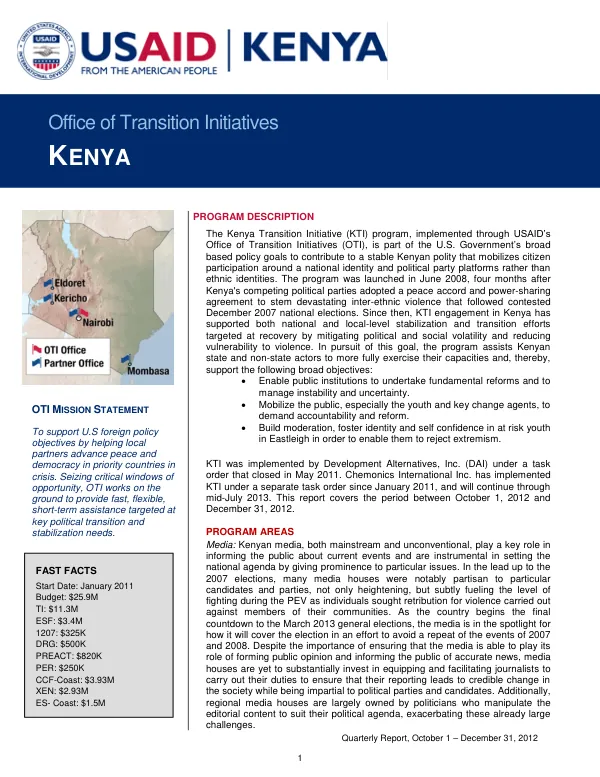
The Kenya Transition Initiative (KTI) program, implemented through USAID's Office of Transition Initiatives (OTI), contributes to the U.S.
2013 · 5 pages
Sign in to readA free account is required to download.
Abstract
Government's broad-based policy goal of a stable Kenyan polity that mobilizes citizen participation around a national identity and political party platforms rather than ethnic identities. The program was launched in June 2008, four months after Kenya's competing political parties adopted a national peace accord and power-sharing agreement to stem devastating inter-ethnic violence that followed the hotly contested December 2007 national elections. Since then, KTI's engagement in Kenya has supported both national and local-level stabilization and transition efforts that mitigate political and social volatility and reduce vulnerability to violence. The program assists Kenyan state and non-state actors based on the following overarching objectives: Enable public institutions to undertake fundamental reforms and to manage instability and uncertainty, and Mobilize the public, especially the youth and key change agents, to demand accountability and reform. In March 2013, Kenya carried out its first General Election under the 2010 Constitution. The elections not only gave Kenya a new president but also gave birth to the new devolved system of governance. In response to these contextual developments, KTI refocused its programming to strengthening public institutions at the county level, helping them to become more proficient, transparent, accountable, and inclusive in governance and service delivery. The program also began working with civil society organizations to effectively represent citizens' interests and aspirations to the county governments. Public Institution Strengthening is a key area of focus for KTI. The program has provided training to County Executive Committees (CECs) to help them understand their roles and responsibilities in the devolved system. In Kwale County, KTI provided a three-day training to the CEC, which helped clear up misunderstandings on the constitutional mandate of each staff position within the CEC. The training also enabled the CEC to better understand the county planning process, including how to generate the county integrated plan, the sectorial plan, and the fiscal strategy paper. To standardize the curriculum for the County Executive, KTI helped the Kenya School of Government develop a course syllabus that would ensure that all CECs have access to the same information on devolution. This will ensure that the training curriculum for the county executives is harmonized across Kenya. KTI has also piloted a record management system for two counties, Nandi and Uasin Gishu, to help them build the capacity of their registries and streamline the process of record management. Media is another key area of focus for KTI. The program has partnered with the media in the Rift Valley region to ensure that local media continues to sensitize and educate the public on the virtues, opportunities, and challenges presented by devolution. KTI has leveraged the influence of radio by partnering with a local Kalenjin Radio station, KASS FM, to provide a platform for discussions on the roles and responsibilities of the new leaders in the devolved system. The transition of power in Kenya was a significant event in the last quarter. Kenya carried out its first general election under the 2010 Constitution, and Kenyans elected county governors, senators, county wards representatives, women representatives, and members of parliament. The elections were hotly contested between the former Prime Minister Raila Odinga and the former Deputy President Uhuru Kenyatta. Mr. Uhuru Kenyatta was declared the winner of the election by the Independent and Electoral Boundaries Commission (IEBC), and this decision was upheld by the Supreme Court of Kenya after a hearing a case challenging the declaration. In this quarter, Mr. Kenyatta was sworn in as Kenya's fourth president, pledging to reconcile the country with the promotion of peace and ending the cycle of violence that accompanied past elections.
Related documents