CHEMONICS
Quarterly Report, October 1 – December 31, 2012
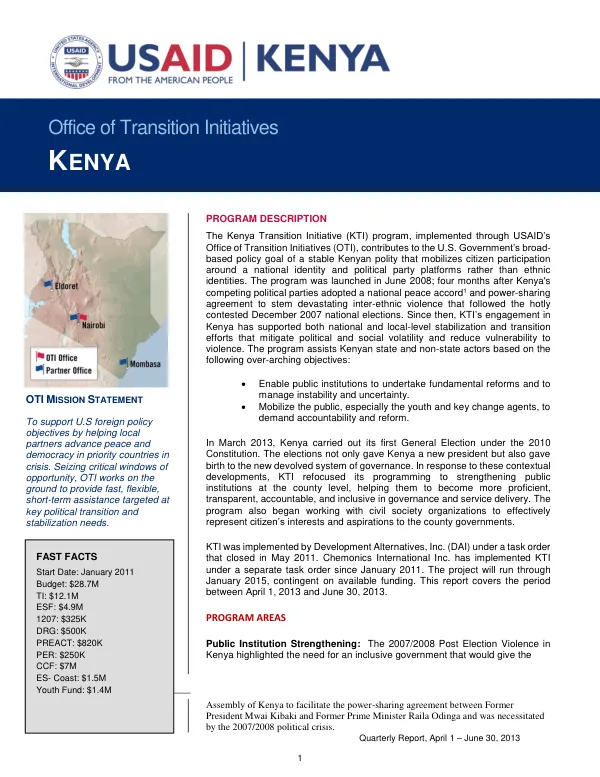
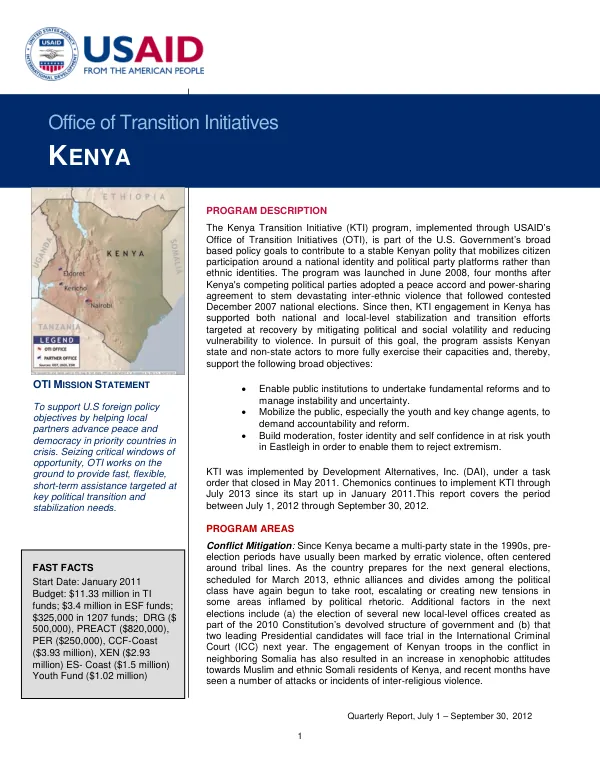
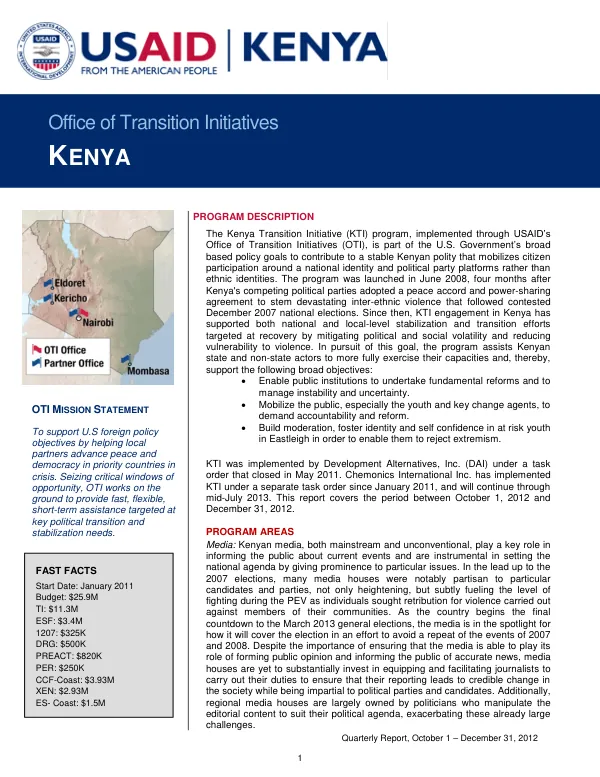
The Kenya Transition Initiative (KTI) program, implemented through USAID's Office of Transition Initiatives (OTI), aims to contribute to a stable Kenyan polity by mobilizing citizen participation around a national identity and political party platforms rather than ethnic identities.
2012 · 6 pages
Sign in to readA free account is required to download.
Abstract
Launched in June 2008, the program supports national and local-level stabilization and transition efforts, targeting recovery by mitigating political and social volatility and reducing vulnerability to violence. Key objectives of the KTI program include enabling public institutions to undertake fundamental reforms and manage instability and uncertainty, mobilizing the public, especially the youth and key change agents, to demand accountability and reform, and building moderation, fostering identity and self-confidence in at-risk youth in Eastleigh to enable them to reject extremism. The program is implemented by Development Alternatives, Inc. (DAI) and Chemonics International Inc. Media plays a crucial role in informing the public about current events and setting the national agenda in Kenya. However, many media houses are yet to invest in equipping and facilitating journalists to carry out their duties impartially, leading to biased reporting that can fuel violence. The KTI program has supported multifaceted activities to promote responsible journalism in both mainstream and alternative media, with the goal of reducing political manipulation and promoting a more informed electorate. Along the Kenyan Coast, calls for secession and a boycott of the 2013 elections by the Mombasa Republican Council (MRC) have left the region divided and tense. In response, the KTI program has begun identifying and developing messages targeting the priorities of the coastal population through a baseline survey in Kilifi, Kwale, and Mombasa counties. The data will be used in the design of a media campaign along the Coast to address misconceptions held around key reforms, including constitutional reform and devolution. Youth engagement is also a key focus of the KTI program. The Ministry of State for Immigration and Registration of Persons has experienced technical hitches in issuing national identity cards, negatively impacting the number of youth voter registrants. To address this, the KTI program provided support to the Kenya's National Youth Bunge Association (NYBA) Coast chapter to implement the "My ID My life" campaign, which streamlined the ID registration process and led to 20,643 people registering in just over two months in five counties. However, thousands of ID cards remained uncollected by early December, prompting the KTI program and its partners to develop a strategy to mobilize coastal residents to collect their ID cards and register to vote before the one-month deadline given by the Independent Electoral and Boundaries Commission (IEBC).
Related documents