USAID DEC
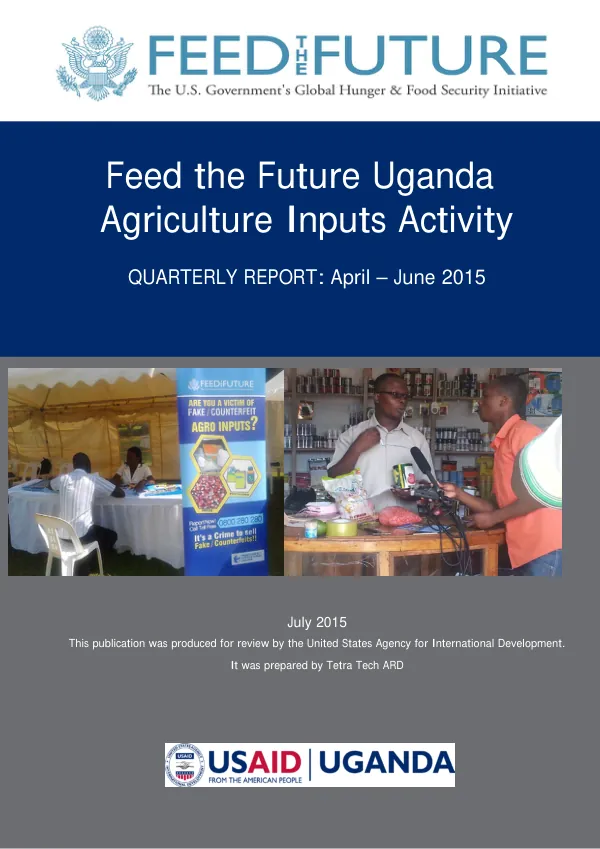
Quarterly Report: April – June 2015, Feed the Future Uganda Agriculture Inputs Activity
Sign inTETRA TECH ARD, INC.
Quarterly Report: April – June 2015, Feed the Future Uganda Agriculture Inputs Activity
The Feed the Future Uganda Agriculture Inputs Activity is a five-year initiative designed to promote the responsible use of agricultural inputs in selected target districts.
2015 · 28 pages
Sign in to readA free account is required to download.
Abstract
The goal of the activity is to increase the use of high-quality agricultural inputs in Uganda through improved availability, decreased prevalence of counterfeit inputs, and strengthened supply chain relationships. The activity is implemented in 18 target districts and utilizes a facilitative approach to leverage market forces and ensure sustainability and scale. Key achievements during the third quarter of the third year of program implementation include support to 2,936 individuals, including 819 women and 1,509 youth, through climate smart agriculture forums, equipment drives, product knowledge trainings, financial literacy trainings, business networks, and marketing and promotional events. Collaboration with industry associations increased this quarter, including the Uganda Seed Trade Association, Uganda National Agro-dealers' Association, and CropLife. Creating awareness for the anti-counterfeit hotline continued, resulting in an increase in the number of calls received and more callers identifying the product manufacturer and brand of counterfeits. The activity is on track to achieve all nine quarterly performance targets as of June 2015. Progress against annual indicators will be shared at the end of the year. With additional funding for the seed sector, several new activities were undertaken this quarter, including financial management training for seed companies, agro-dealer seed demonstrations, district level agro-dealer fairs, and registration for an online agricultural inputs platform. Seven district fairs attracted over 300 agro-dealers and suppliers, who benefited from information on a wide range of new products and services. A mid-project strategic assessment was carried out in May/June 2015 to review progress to date, re-evaluate the underlying theory of change, and identify potential areas of improvement. The assessment revealed the need for a revision in the current theory of change to place more emphasis on changing the business environment and incentive structures, as well as fostering greater cooperation among actors to achieve the desired systemic change and create opportunities for win-win solutions. The activity has made significant progress in increasing the availability of high-quality agricultural inputs to farmers in Feed the Future target districts. The production of certified maize and bean seeds has increased, and the development of e-verification systems has supported the decrease in prevalence of counterfeit agricultural inputs. The activity has also strengthened supply chain relationships and increased the capacity of domestic agriculture input associations to regulate, convene, and advocate for their members. The Feed the Future Uganda Agriculture Inputs Activity has a strong focus on increasing the participation of women and youth in the ag-inputs supply chain and strengthening climate change adaptation. The activity has implemented cross-cutting activities to achieve these goals, including climate smart agriculture forums, equipment drives, and product knowledge trainings. The activity has also collaborated with other Feed the Future Uganda activities, including the Commodity Production and Marketing Activity and USAID/Education Research and Innovation in Climate Change (ERICCA), to achieve these goals. The activity has a robust monitoring and evaluation system in place to track progress against performance targets and annual indicators. The system includes regular reporting, data collection, and analysis to ensure that the activity is on track to achieve its goals. The activity also has a strong focus on learning and adaptation, with regular assessments and evaluations to identify areas for improvement and adjust the activity's approach as needed.