IRC
SCALE Quarterly Report Q1Y4
Strengthening Capacity in Agriculture, Livelihoods, and Environment (SCALE) is a TOPS associate award designed to improve the impact, sustainability, and scalability of the USAID Bureau for Humanitarian Assistance's (BHA) activities in agriculture, natural resource management, and livelihoods.
2021 · 10 pages
Sign in to readA free account is required to download.
Abstract
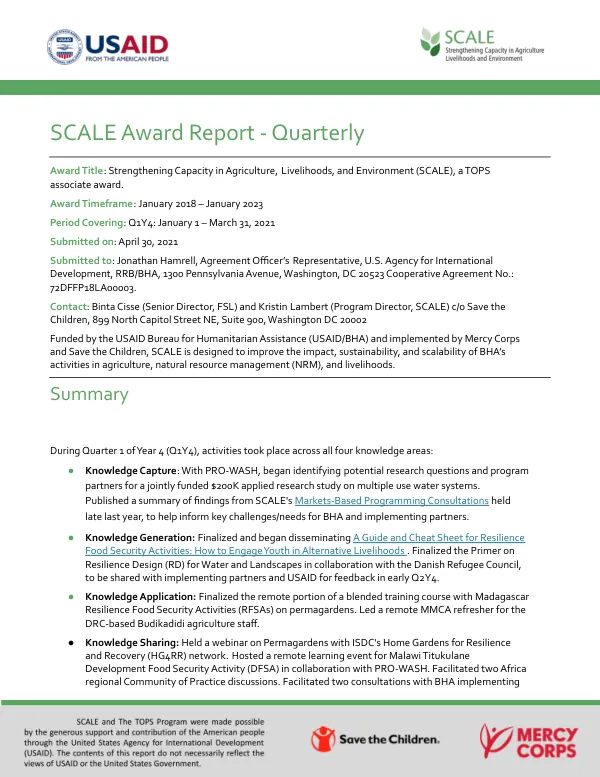
The award is implemented by Mercy Corps and Save the Children, with funding from the USAID Bureau for Humanitarian Assistance (USAID/BHA). During Quarter 1 of Year 4 (Q1Y4), activities took place across all four knowledge areas. In Knowledge Capture, SCALE began identifying potential research questions and program partners for a jointly funded $200,000 applied research study on multiple use water systems with PRO-WASH. A summary of findings from SCALE's Markets-Based Programming Consultations was published to inform key challenges and needs for BHA and implementing partners. In Knowledge Generation, SCALE finalized and began disseminating A Guide and Cheat Sheet for Resilience Food Security Activities: How to Engage Youth in Alternative Livelihoods. The Primer on Resilience Design (RD) for Water and Landscapes in collaboration with the Danish Refugee Council was also finalized and will be shared with implementing partners and USAID for feedback in early Q2Y4. Knowledge Application focused on finalizing the remote portion of a blended training course with Madagascar Resilience Food Security Activities (RFSAs) on permagardens. A remote MMCA refresher was led for the DRC-based Budikadidi agriculture staff. In Knowledge Sharing, a webinar on Permagardens was held with ISDC's Home Gardens for Resilience and Recovery (HG4RR) network, and a remote learning event was hosted for Malawi Titukulane Development Food Security Activity (DFSA) in collaboration with PRO-WASH. Adaptive Program Management involved combining responses from IDEAL's annual survey with data from SCALE-specific outreach to obtain outcome-level indicator data. The Year 3 outcome-level indicator data has been included in this report. SCALE's targets for one of its Goal-level indicators were revised in the Year 4 approved work plan. The SCALE Technical Committee (TC) meeting was held on February 25, 2021, where SCALE shared brief updates on ongoing activities and upcoming priorities. A discussion on the economic analysis requirement in RFSA Request for Applications (RFAs) took place, and SCALE will remain in contact with BHA about hosting a stakeholder consultation on this in Q2Y4. Case Studies and Lessons Learned involved finalizing and disseminating an external summary of last year's consultations on the challenges, opportunities, and needs related to market-based programming in BHA-funded activities. The findings include strengthening producer organizations, integrating market-based approaches in livelihoods activities, and advancing market systems development. Testing Impact of Agricultural Technologies - Research planning discussions began with PRO-WASH on a jointly funded $200,000 applied research study focused on Sustainability and Resilience of Multiple-Use Water Systems (MUS) in USAID Title II Countries. An interest survey was circulated to implementing partners to inform the design of the RFA and identify a potential program partner with whom this research could take place. Training of Trainer Materials involved recruiting a partner to develop the MMCA e-learning course in collaboration with PRO-WASH. Course design will begin in Q2Y4. The Amharic version of the Make Me a Change Agent (MMCA) guide will be published in Q2Y4 following a final copyedit and formatting by the IDEAL communication's team. Tools, Guides and Manuals included partnering with the Danish Refugee Council (DRC) to finalize a technical primer on Resilience Design for Water and Landscapes. The primer includes a case study and practical guidance for implementing partners on integrating resilient infrastructure, water harvesting, food forestry, and agricultural production. Materials will be shared with implementing partners and USAID for review and feedback in early Q2Y4. Capacity Strengthening involved finalizing the online series of six sessions that were delivered through Google Classroom for the Madagascar Permagarden training. The training was rescheduled for Q2Y4 due to competing priorities amongst the RFSA partners.