USAID
Quarterly Report April – June 2016
The activity, which began on July 1, 2015, and is set to conclude on June 30, 2019, aims to support educated women between the ages of 18 and 30 in finding new or better jobs through career counseling, workplace skills development, and technical skills training based on market demand.
2016 · 42 pages
Sign in to readA free account is required to download.
Abstract
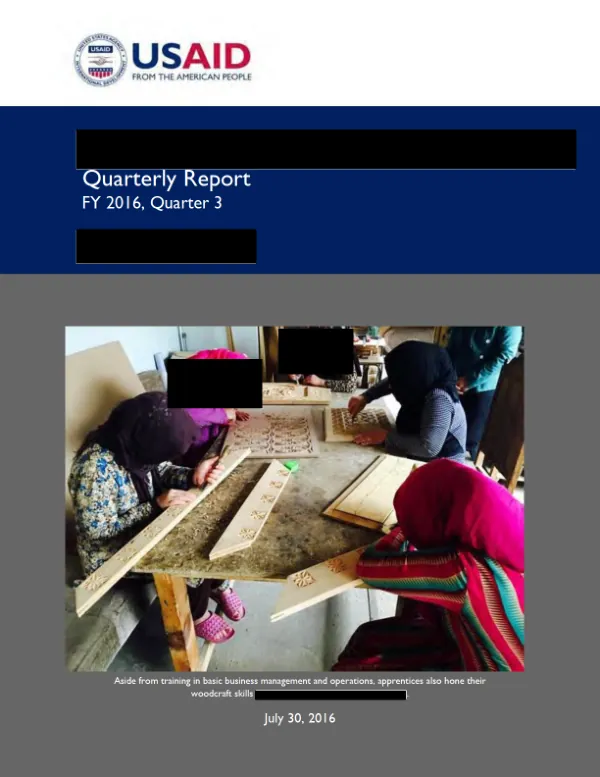
This is achieved by partnering with local educational, vocational, and technical training providers to deliver services, and by funding scholarships for training and certification programs. The project also supports internships, apprenticeships, and job placement services that give women the opportunity to gain work experience, prove their capabilities to employers, and secure new or better positions. Additionally, the project incentivizes companies to improve workplace environments for women. The project's projected achievements include a 20 percent increase in the number of supported businesses that move to the next level of enterprise size, with 50 percent or more of all supported businesses increasing revenues by more than 40 percent within two years after assistance. Furthermore, the project aims to provide new or better employment to 21,000 women, with 12,600 women receiving a 10 percent or greater improvement in wages or income. The project also plans to have 9,500 women participate in activity-supported apprenticeships or internships, and to develop three gender-sensitive policies, regulations, or reforms to assist women in the economy. Component 1 – Private Sector Development (PSD) focuses on supporting businesses in improving their workplace environments for women. This includes providing training and technical assistance to businesses, as well as incentivizing them to adopt gender-sensitive policies and practices. Component 2 – Workforce Development (WfD) focuses on providing career counseling, workplace skills development, and technical skills training to educated women between the ages of 18 and 30. This includes partnering with local educational, vocational, and technical training providers to deliver services, and funding scholarships for training and certification programs. Component 3 – Technical Services (TS) provides technical assistance and support to businesses and individuals, including training and capacity building, as well as access to information and communications technology. During the quarter, key activities accomplished in Component 1 – PSD included providing training and technical assistance to 15 businesses, with a focus on improving their workplace environments for women. In Component 2 – WfD, 2,500 women received career counseling and workplace skills development training, with 1,200 women participating in internships and apprenticeships. In Component 3 – TS, 500 individuals received training and capacity building support, with a focus on improving their technical skills and access to information and communications technology. The project also collaborated with the Government of the Islamic Republic of Afghanistan (GIRoA) and other agencies, including the Ministry of Labor, Social Affairs, Martyrs and Disabled (MoLSAMD) and the Ministry of Women's Affairs (MoWA). The project also worked with other USAID projects, including the Afghanistan Investment Support Agency (AISA) and the Afghanistan Microfinance Association (AMA).