DAI
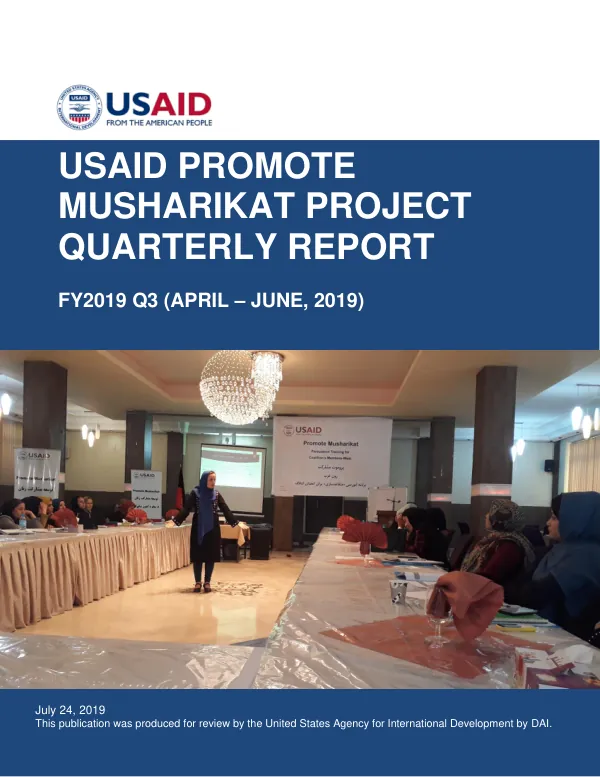
USAID Promote Musharikat Quarterly Report FY2019 Q3
The USAID Promote Musharikat project is a quarterly report for FY2019 Q3, covering the period from April to June 2019.
2019 · 27 pages
Sign in to readA free account is required to download.
Abstract
The project aims to promote women's equality and empowerment in Afghanistan through various objectives and activities. Under Objective 1, Building Constituencies among National, Provincial, and Local Activists and Groups Focused on Promoting Women's Equality and Empowerment, Musharikat continued to make progress in peace process and coalition recruitment and engagement tasks. The project trained 496 coalition members in persuasion through 23 training sessions in all five project regions. Musharikat also registered 711 new activists, raising the project to-date total to 3,832. The ICT and Communications team introduced new changes to the Musharikat Knowledge Management Platform (MKMP) and additional initiatives to improve online engagement of members, resulting in an increase of over 6,000 MKMP member views compared to the previous quarter. Under Objective 2, Strengthen More Effective Issue-Based Advocacy for Women's Equality and Empowerment, Musharikat continued to provide technical strategy and planning support to established coalitions. The project facilitated a fifth and final Advocacy Campaign Planning session with the Anti-Harassment of Women and Girls (AHWG) coalition and worked closely with various coalitions to develop and finalize respective action plans. Under Objective 3, Increase Awareness and Support for Women's Rights in All 34 Provinces of Afghanistan, two active grantees conducted positive masculinity training through the Musharikat grants framework, training 695 male participants in five provinces within the quarter. The grantees also provided the Musharikat Grants team with important lessons learned and findings from their experience conducting the trainings. Under Objective 4, Civil Society and GIROA Are More Effective Partners in Strengthening the Development and Implementation of Gender Policies, Musharikat implemented two primary advocacy activities through its AHWG, AJ, and AE coalitions. As a result of AHWG and AJ advocacy efforts, Musharikat facilitated the establishment of 14 Women and Children's Anti-Harassment committees in seven provinces, within each province's Directorate of Education (DoE) and Provincial Council (PC). In addition to the program activities implemented under Objective 3, the Musharikat Grants team made significant progress with the Request for Applications (RFA) phase in preparation for active grant implementation in FY2019 Q4. The Grants team conditionally-selected seven Civil Society Organizations (CSOs) to implement activities across three RFAs and finalized grant packages for each CSO. The report also details important information related to Musharikat management, staffing, partner coordination, key challenges, and general plans for the next quarter. The project's performance indicators show progress in various areas, including the number of civil society organizations receiving USG assistance engaged in advocacy interventions, the number of individuals participating in Musharikat issue-based coalitions, and the percentage of organizations and groups participating in Musharikat issue-based coalitions using social and traditional media. The project's quarterly summary highlights key activity results, including the number of new activists registered, the number of training sessions conducted, and the number of individuals participating in Musharikat issue-based coalitions. The report also includes a table showing the project's performance indicators, including the percentage of Musharikat grants completed with at least 75% of their deliverables successfully delivered and the number of civil society organizations receiving USG assistance engaged in advocacy interventions.