CENTER FOR EDUCATIONAL DEVELOPMENT
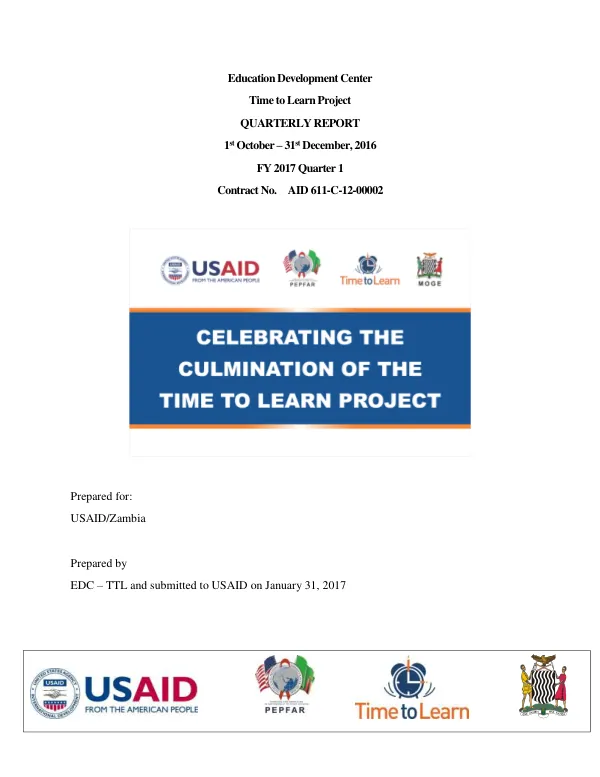
Quarterly Report FY 2017
The Time to Learn (TTL) project is USAID/Zambia's education program aimed at improving educational outcomes among orphaned and vulnerable children (OVC) enrolled in community schools.
2017 · 52 pages
Sign in to readA free account is required to download.
Abstract
The project partners with the Ministry of General Education (MoGE) to develop an effective, replicable, and sustainable model for improving reading performance and responding to the economic, social, and psychological complexities faced by OVC. This includes providing scholarships to assist OVC through the higher grades. TTL's key purpose is to sustainably improve the quality of education in community schools and institutionalize, in a decentralized way, MoGE support to community schools to stabilize their operations. This is being done by providing educational resources, improving teacher skills and school management, and enhancing learner support through community and private sector participation. Addressing four key task areas, TTL assists the MoGE to promote a favorable environment for MoGE engagement at all levels to support community schools, promote HIV/AIDS prevention and provide a continuum of educational and financial support to enable OVC to participate in upper basic and secondary education, develop the capacity of local community groups and NGOs to advocate for opportunities for children in greatest need, and support opportunities to engage universities and other institutions in research related to promoting educational opportunities for OVC. During the reporting period, TTL services were extended to other provinces, with 18 officials from the Ministry of Education trained as Trainers of Trainers in using the Stepping Stone phone platform, and 40 DRCCs and Assistant DRCCs trained in using the Stepping Stone phone platform. End-line data collection was conducted, and 359,110 Teaching and Learning Materials (TLMs) were distributed. A Context Study was disseminated, and 4,599 Parent-Teacher Partnerships (PTPs) for TLMs were established. A culmination event was held on November 16th at Tionge Community School. The project achieved significant results in terms of training officials, distributing TLMs, and supporting community schools. A total of 5,134 officials were trained, with 3,294 males and 1,840 females. The number of teachers who successfully completed TTL in-service training in reading increased to 11,266, with 6,634 males and 4,632 females. The project also distributed 931,229 TLMs, exceeding the target of 750,000. The number of learners enrolled in primary schools and/or equivalent non-school-based settings with USG support increased to 500,811, with 256,409 males and 244,402 females. The project also made significant progress in supporting Parent-Teacher Associations (PTAs) and School Governance Structures (SGSs). A total of 6,100 PTAs and SGSs were supported, with 4,200 trained and 1,900 committees trained/supported. The project also supported the enrollment of 500,000 students in grades one to four in TTL-supported community schools, with 250,000 males and 250,000 females. In terms of outcomes, the project achieved significant results in improving reading outcomes among learners. The proportion of learners in TTL-supported community schools who, at the end of two grades of primary schooling, demonstrate that they can read and understand the meaning of grade level text increased to 1.6%. The number of learners who gained the ability to read at least one letter sound correctly increased to 210,000, and the number of learners who gained the ability to read at least one word correctly increased to 55,000. Overall, the TTL project has made significant progress in improving educational outcomes among OVC in community schools in Zambia. The project's focus on improving reading instruction, providing educational resources, and enhancing learner support has resulted in significant improvements in reading outcomes among learners.
Related documents