USAID DEC
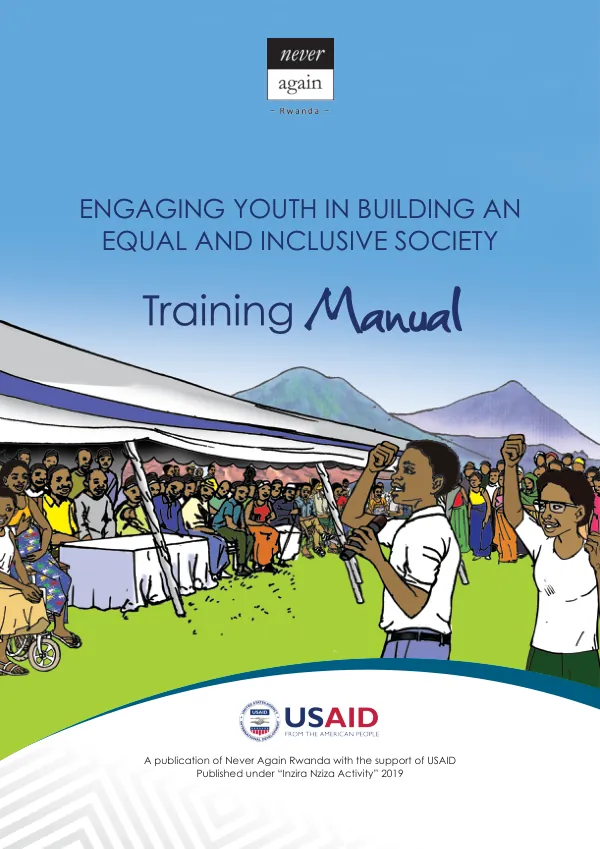
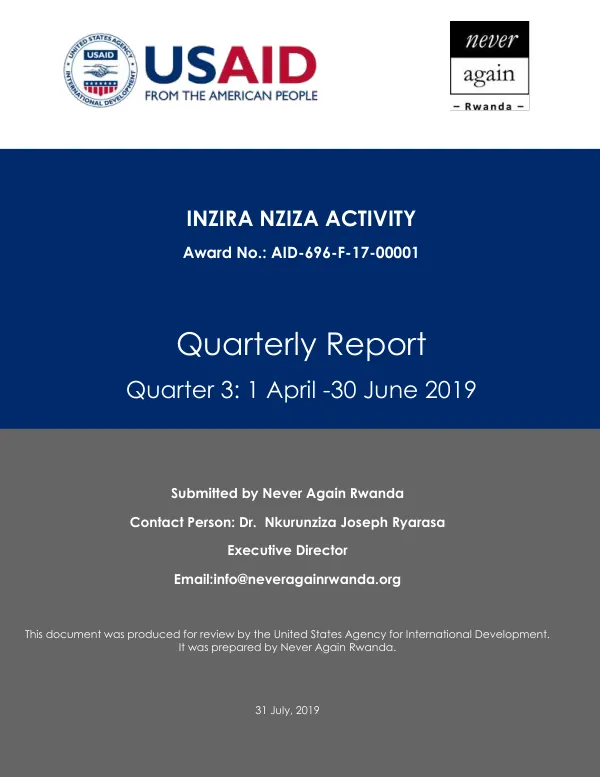
Quarterly Report: Inzira Nziza Activity, Quarter 3: 1 April -30 June 2019
Inzira Nziza is a three-year funded activity by USAID Rwanda, implemented by Never Again Rwanda in five districts of Rwanda.
2019 · 37 pages
Sign in to readA free account is required to download.
Abstract
The overarching goal is to contribute to the promotion of peaceful dialogue and democratic values through human rights-based approaches, influencing the understanding of the rights of the most vulnerable groups in Rwanda. The activity's theory of change posits that if youth capacities are improved and oriented towards independent thinking, they will develop self-confidence and influence communities, local authorities, and government decision-making in policy formulation and implementation. The specific objective is to support young people to express and debate their views on democratic values, take on leadership roles, and promote and protect human rights. To achieve this objective, the activity engages a two-fold approach aimed at enhancing the capacity of youth with self-confidence and stronger partnerships for improved collaboration with local government, the electoral commission, and political parties. The activity engages participatory and critical thinking approaches to help youth increase participation in decision-making and democratic governance in their communities and at the national level. In the third quarter of 2019, the activities implemented under Inzira Nziza aimed to increase the participation of youth in local governance, engaging an essential demographic in the function and development of Rwanda. The programmatic activities contributed to the increased confidence among participating youth in their interactions with local representatives and increased youth capacity to challenge local leadership on issues relating to youth needs and priorities. During this quarter, Inzira Nziza participants in their respective districts were engaged in commemoration activities and independently organized commemoration events as a way of owning the culture of commemoration and their responsibility to carry on the commemoration practice to the next generations. Inzira Nziza youth beneficiaries and local leaders also received follow-up trainings to ensure the sustainability of Inzira Nziza's impact. The activity engaged local leaders and youth participants in more participatory approaches, including lectures, case studies, and mixed group works. Youth were introduced to the principles of democracy, the importance of political participation, and various ways of engagement as well as strategies to mitigate radicalism and transform violent extremism. Group work and peer collaboration were facilitated in brainstorming exercises to jointly adopt solutions to the lingering issues that challenge youth. Local government leaders attended all Inzira Nziza activities, and in these spaces, youth participants were empowered to speak out and highlight issues contributing to low levels of youth participation. Participants exposed gaps in policies, including existing citizen participation frameworks, and spoke about youth-centered issues that are not being given enough attention in more mainstream forums. Through the public forum debates, youth even highlighted the ineffective representation at various levels of government due to limited confidence and commitment of their elected representatives, to which the local leadership responded and promised to address all the complaints. Inzira Nziza activities were not limited to youth alone. District roundtable discussions and public forum debates sessions provided platforms for local leaders to interact directly with youth and provide feedback on concerns raised, like unemployment and low levels of youth political participation. Community members and local leaders learned from youth about common practices, both active and passive, which impede youth participation. Finally, leaders used Inzira Nziza sessions to remind youth about existing resources in community forums and local government and emphasized the importance of youth taking charge of their own lives. The major activities planned for the third quarter included conducting annual debate competitions on human rights, democracy, and citizen participation in Nyamagabe, Huye, and Gisagara; joint training for youth champions and local leaders in Nyamagabe, Huye, and Gisagara; holding quarterly roundtable discussions in Ngororero and Nyabihu District; conducting the assessment to identify local youth-oriented CSOs; and implementing the Face to Face Youth Portal.