USAID DEC
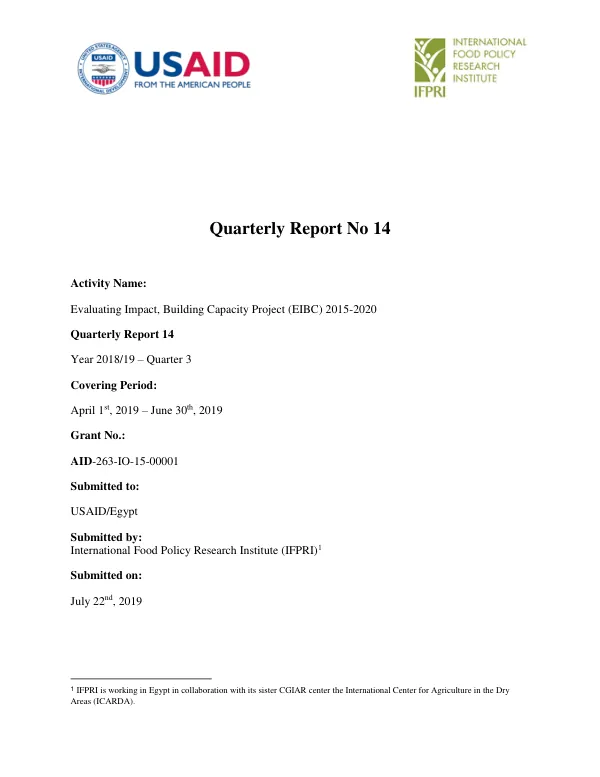
Quarterly Report No 14: Evaluating Impact, Building Capacity Project (EIBC) 2015-2020
Sign inFOOD AND AGRICULTURE ORGANIZATION OF THE UNITED NATIONS IN GEORGIA
Quarterly Report No 14: Evaluating Impact, Building Capacity Project (EIBC) 2015-2020
The Evaluating Impact, Building Capacity Project (EIBC) is a five-year initiative implemented by the International Food Policy Research Institute (IFPRI) in Egypt, with funding from the United States Agency for International Development (USAID).
2019 · 33 pages
Sign in to readA free account is required to download.
Abstract
The project aims to contribute to rural income growth, poverty reduction, food security, and adequate nutrition in Egypt. To achieve this goal, the EIBC project has three components: impact evaluation, capacity building, and promotion of evidence-based policy making. Impact evaluation is a key component of the EIBC project, focusing on the assessment of USAID-funded agriculture and nutrition-related programs in Upper Egypt. IFPRI has published a working paper and a policy note on the characteristics of farm households in rural Upper Egypt, highlighting the potential for agriculture to improve health and nutrition. The findings of the baseline survey conducted for the evaluation of the Food-Security and Agribusiness Support (FAS) and Improving Maternal, Child Health and Nutrition Services (IMCHN) programs have been shared with policymakers, donors, and development partners. Capacity building is another critical component of the EIBC project, focusing on the development of the Ministry of Agriculture and Land Reclamation's (MOALR) monitoring and evaluation (M&E) capacity. IFPRI has been updating the MAP Egypt tool, which has gained significant interest from stakeholders. The tool was presented to the new FAR-MOALR Head, who expressed strong interest in its launch and other cyber security-related issues. The promotion of evidence-based policy making is the third component of the EIBC project, focusing on the provision of actionable research and policy advisory services. Component 3 has two sub-components: the IFPRI-USAID seminar series and two actionable research topics, Climate Smart Agriculture (CSA) and Cluster-based Development (CBD) in rural areas. IFPRI conducted three seminars during the quarter, attended by over 300 participants, and organized a seminar on climate-smart agriculture, where the findings of IFPRI's research under this component were presented. The EIBC project has also engaged in various meetings and activities with implementing partners, including USAID, the Italian Cooperation, and the Ministry of Health and Population (MOHP). These meetings aimed to strengthen cooperation, discuss project updates, and address challenges facing both IFPRI and other implementing partners. The project has also made significant progress in its capacity building component, with IFPRI updating the MAP Egypt tool and presenting it to the new FAR-MOALR Head. In terms of geographic focus, the EIBC project is concentrated in Upper Egypt, with a focus on the assessment of USAID-funded agriculture and nutrition-related programs. The project has also engaged with various stakeholders, including policymakers, donors, and development partners, to promote evidence-based policy making and improve the M&E capacity of the MOALR. Overall, the EIBC project has made significant progress in its impact evaluation, capacity building, and promotion of evidence-based policy making components. The project's focus on Upper Egypt and its engagement with various stakeholders have contributed to its success in promoting rural income growth, poverty reduction, food security, and adequate nutrition in Egypt.