COUNTER PART INTERNATIONAL
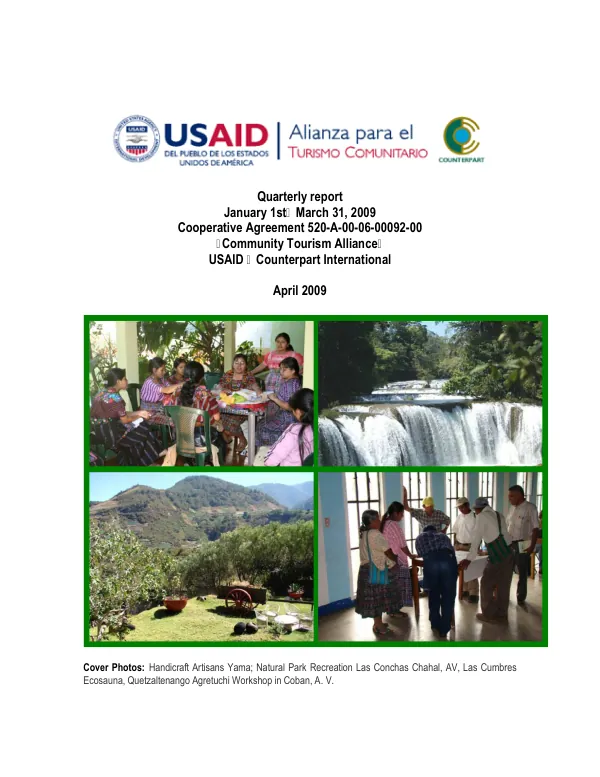
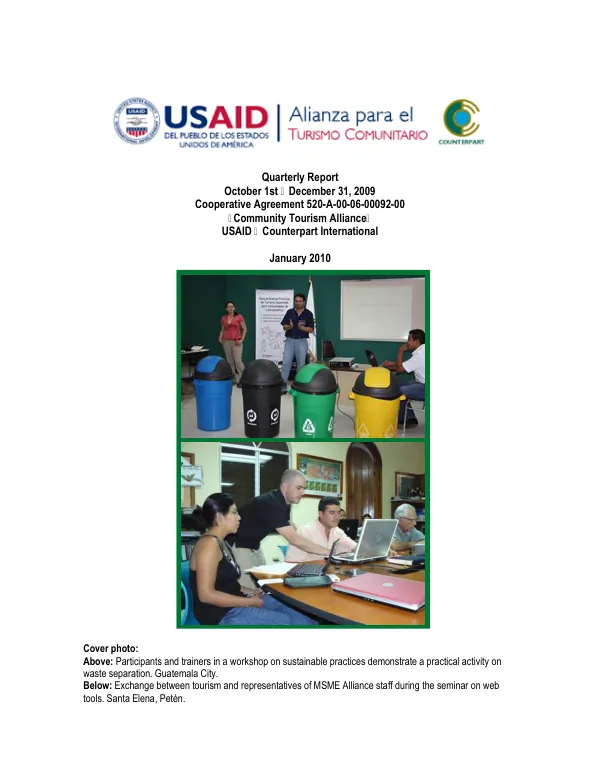
Quarterly Report October – December 2009: Community Tourism Alliance
The Community Tourism Alliance project, a cooperative agreement between USAID and Counterpart International, continued to develop its activities in accordance with the approved work plan for fiscal year 2010.
2009 · 36 pages
Sign in to readA free account is required to download.
Abstract
The project's primary focus was on strengthening local, regional, and national tourism organizations, as well as promoting good management practices and certification. In the Maya Biosphere Reserve, the project continued to support the ACOFOP Tourism Commission and implemented joint activities with Balam Association of Carmelite and Uaxactun communities. A tour of experience sharing was conducted between members of the Tourism Commission of ACOFOP and the communities around Candelaria Caves National Park to meet the management of community tourist destinations and see the results of their existing cooperation agreement with the Ministry of Culture and Sports (IDAEH). Following the tour, a meeting was held with representatives of IDAEH to publicize the content of the Law on Protection of Cultural Heritage of the Nation to leaders at ACOFOP partner organizations. The project also provided technical support to the consulting firm hired by the PDPCRBM to develop the feasibility study of the Community School of Tourism of the Maya Biosphere Reserve, managed by ACOFOP and supported by Counterpart. In Uaxactún and Carmelita, the project began to work to further strengthen the organizational structure of the tourism commission with special emphasis on administrative and accounting aspects. Training activities will focus on the themes of archeology, bird watching, food handling, first aid, and implemented mechanisms to maintain close coordination with the IDB-financed project executed by MIF FUNDESA and PACUNAM. In the component of access to credit and financial services, 40 beneficiaries are receiving technical assistance, including individual entrepreneurs and community organizations. The projects are extremely diverse, including construction or expansion of hotels and eco-lodges, purchase of vehicles for transporting tourists, Spanish school building, equipment, trails, and craft production. A total of 6 project profiles have been submitted to Banrural, which are being evaluated by bank personnel, and two profiles are being finalized to appear early next quarter. The project also continued to advise COTURAP and CONAP in the process of reviewing and updating the Ecotourism Management Tools for the Guatemalan System of Protected Areas. A committee was formed with representatives of members of COTURAP, producing a new Regulation for the Management and Development of Visitation in Protected Areas. This document is currently under final review by the legal department of CONAP and regulates all aspects related to the planning and development of activities that involve visits to protected areas. In addition, the project facilitated contacts and relations between INTECAP, INGUAT, local communities, and other institutions to support the implementation of the courses of the Community Tourism Guide. These courses have been implemented with a focus on communities related to protected areas, supporting the sustainable management of natural resources through community tourism and in turn generating new jobs. During this quarter, Counterpart coordinated the implementation of courses in 18 communities with the participation of 93 people, including 25 women.
Related documents