TETRA TECH
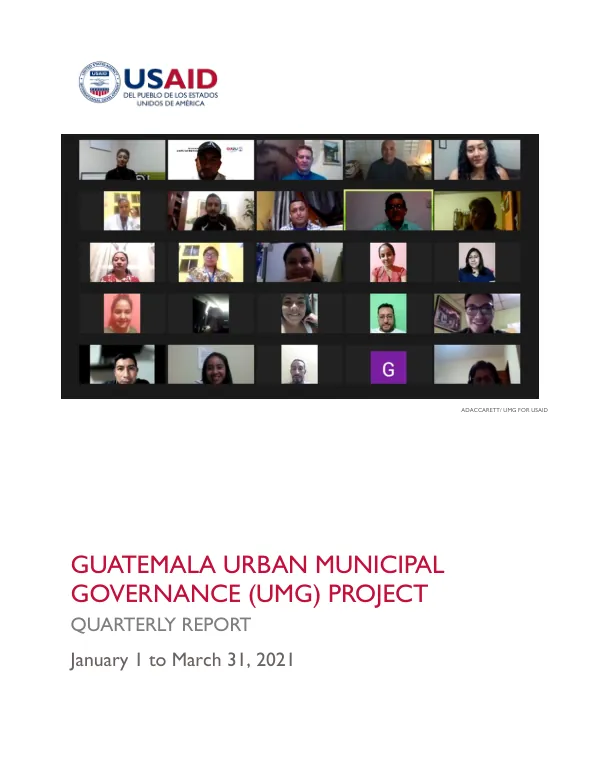
Guatemala UMG: Quarterly Report, April-June 2021
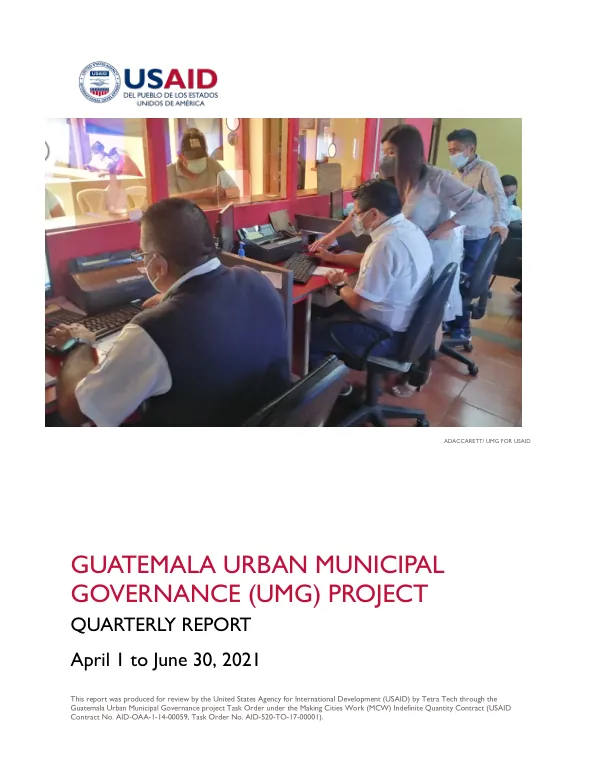
The Guatemala Urban Municipal Governance (UMG) project is a five-year initiative designed to reduce levels of violence in municipalities most at risk of violent crime through enhanced municipal governance, increased coverage and quality of municipal services, and greater citizen participation and oversight.
2021 · 35 pages
Sign in to readA free account is required to download.
Abstract
The project provides municipal governments with improved technology solutions and technical assistance to achieve transparent and participatory planning, financial management, and effective service delivery implementation. The UMG project is organized to achieve three primary objectives: municipal strengthening, service delivery improvement, and citizen engagement. The first objective, strengthening municipal performance, involves establishing strong public budgeting for crime and violence prevention related activities. The second objective, service delivery improvement, aims to enhance living conditions and municipal services in high-crime, urban marginalized communities through citizen-driven improvements. The third objective, citizen engagement, seeks to actively involve citizens and civil society in municipal decision-making and accountability processes. As the UMG project enters its final months of implementation, its focus shifts to institutionalizing program activities and leaving a lasting legacy of strengthened municipal-level governance and reduced crime, violence, and migration. The project has worked with partner municipalities, national institutions, and local civil society organizations to implement various strategies, including Functional Organizational Capacity Assessments (FOCAS) at the municipal level and vocational training and alternative education for youth at the community level to prevent violence. The project's sustainability is based on four levels of support to local partners. The first level involves generating models and solutions conducive to replication by current and future partners. The second level focuses on strengthening linkages between national institutions and local governments to access and implement successful national-level models. The third level introduces new technology and tools to improve local actor capacity, such as information technology to accelerate progress and promote sustainability. The fourth level strengthens municipal capacity to generate own source revenue through improved tax and service fee collection mechanisms. During Fiscal Year 2021, the UMG project has made significant progress in achieving its objectives. The project has strengthened the capacity of municipal governments, communities, and civil society organizations, resulting in effective interventions, methods, and tools. For example, the project has helped municipalities adopt the Secretariat of the Presidency for Planning and Programming (SEGEPLAN) tools to strengthen municipal planning efforts and has facilitated the roll-out of key models and methodologies. The project has also introduced new technology and tools to improve local actor capacity, such as the GLPortal system for online municipal service fee collection and the development of an effective tool to better identify youth most at risk of crime and violence. Additionally, the project has strengthened municipal capacity to generate own source revenue through improved tax and service fee collection mechanisms, resulting in increased income and higher quality services. The UMG project's efforts to institutionalize its methodologies in support of Guatemala's Journey to Self-Reliance are ongoing. The project's focus on sustainability and replication of effective interventions will contribute to the reduction of crime, violence, and migration in Guatemala's municipalities.