ACDI/VOCA
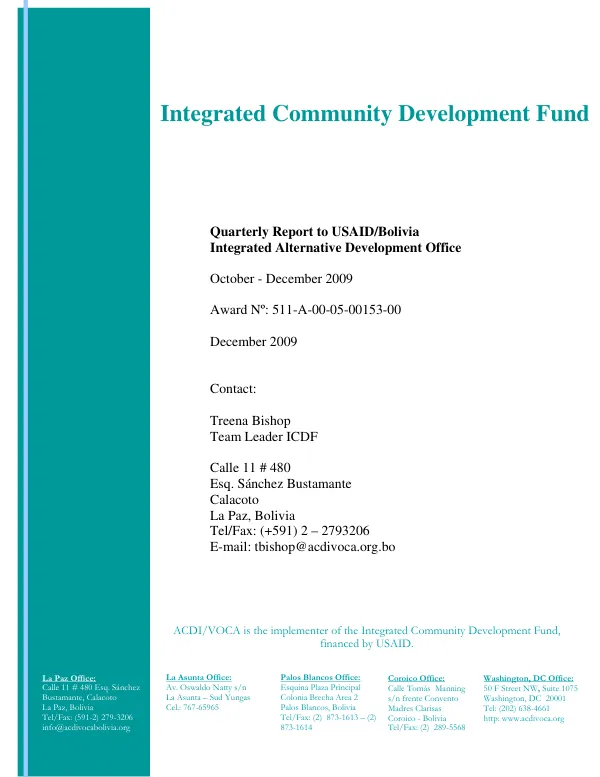
Quarterly Report to USAID/Bolivia Integrated Alternative Development Office
The Integrated Community Development Fund (ICDF) is a five-year program implemented by ACDI/VOCA in Bolivia, with funding from the United States Agency for International Development (USAID).
2009 · 90 pages
Sign in to readA free account is required to download.
Abstract
The program's primary goal is to support the joint efforts of the US government and the Plurinational State of Bolivia to establish a sustainable economy in Bolivia's coca-producing regions. The ICDF's strategy is to meet basic human needs and alleviate poverty by improving social and economic conditions in the Yungas of La Paz and the Tropics of Cochabamba. The ICDF's methodology was adjusted in 2009 to more directly respond to the diverse development needs of the region and to support the policies and strategy of the Plurinational State of Bolivia. The program was restructured to reflect two components: economic and community development. During the reporting period, USAID asked ACDI/VOCA to elaborate a Request for Revised Application (RFRA) to include new activities and broaden the reach of existing activities. The RFRA was approved, resulting in Modification 15. The ICDF has maintained its primary goal of supporting the joint efforts of the US government and the Plurinational State of Bolivia to establish a sustainable economy in Bolivia's coca-producing regions. The program's strategy is to meet basic human needs and alleviate poverty by improving social and economic conditions in the Yungas of La Paz and the Tropics of Cochabamba. The ICDF's overall objectives are to improve the quality of life of community members in ICDF target areas and to contribute to the reduction of structural poverty. During the reporting period, the ICDF accomplished multiple key activities contributing to its overall objectives. Highlights include the approval of 38 new projects, including 28 community development and 10 economic development projects, with a total budget of slightly more than US$1 million. The ICDF also broke ground on nine new community and four new economic development infrastructure projects, including teacher housing in three communities and flood prevention infrastructure along the Ebenay River. The ICDF conducted a training for community development project managers and staff, focusing on project management, monitoring and evaluation, and financial management. The program also began work on the final component of the ICDF mid-term evaluation, which aims to determine the ICDF's impact on the quality of life of community members in ICDF target areas and to determine how much the ICDF contributed to the significant reduction in structural poverty documented in the most recent Unsatisfied Basic Needs (NBI) study. At the close of the quarter, the total number of small-grant development projects under the ICDF was 585, including 318 community development projects and 267 economic development projects. During the quarter, 38 new projects were added, and 53 ICDF projects were concluded, including 10 community development projects and 43 economic development projects. To date, 409 subaward projects have been completed.