ACDI/VOCA
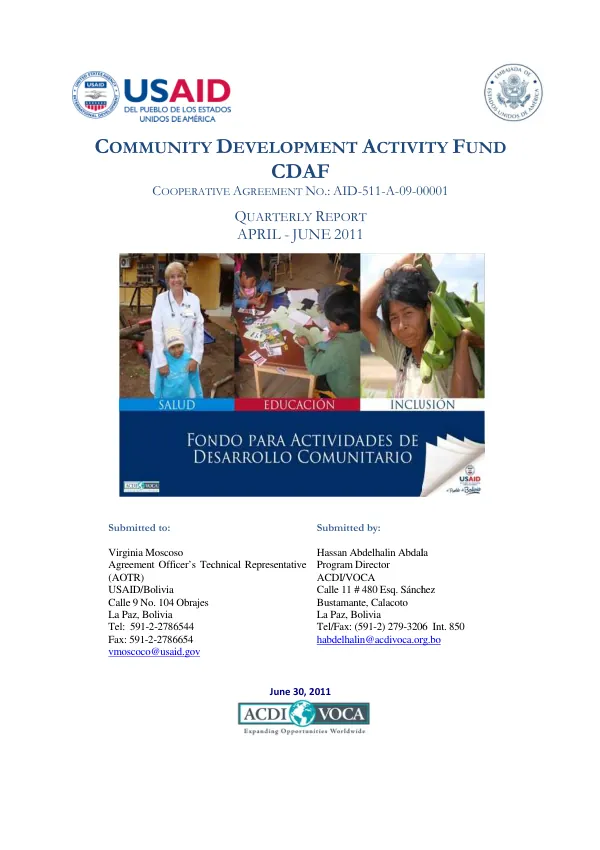
Quarterly Report April-June 2011
The Community Development Activity Fund (CDAF) Program began on September 30, 2009, with the overall goal of supporting communities throughout Bolivia in meeting their basic needs.
2011 · 20 pages
Sign in to readA free account is required to download.
Abstract
The project's purpose is to assist underserved communities to resolve specific, self-identified problems through small grants. The objectives are to finance small-scale development activities that build local problem-solving capacities and contribute to promoting a better understanding of the United States Government (USG) and its development assistance in Bolivia. To achieve these goals and objectives, ACDI/VOCA implements the CDAF Program in close coordination and consultation with USAID and through a series of activities designed to empower communities to achieve their social and economic development objectives. Over the five-year life of the project, the CDAF Program will implement more than 110 small-grant projects throughout Bolivia, with particular emphasis on benefitting traditionally excluded segments of the population, including women and indigenous groups. During the third quarter of FY 2011 (April 1 - June 31, 2011), the following key activities were completed: USAID requested a modification to the CDAF agreement to amend the project indicators, approve the grants manual and Performance Monitoring Plan (PMP), and initiate the monitoring and evaluation of completed projects. Meetings and follow-up visits were held for various projects in different departments and municipalities, and the program's Information Management System (Sistema de Información del Fondo para Actividades de Desarrollo Comunitario (SICDAF)) was updated. Three agreements were made this quarter: one with the local authorities of the community of Jerusalén for the refurbishment of classrooms located in the Municipality of San Andrés de Machaca, a second agreement with the church of Curahuara de Carangas to provide for a library, and a third agreement with the Unidad Educativa Litoral “B” for the provision of kitchen and dining equipment. The monitoring process was begun under Lic. Sergio Urioste in the department of Potosí. Meetings were held with various stakeholders, including Virginia Moscoso (AOTR-USAID), the Bolivia Communications Activist, and representatives from the community of Jerusalén, the Siglo XXI Institution, and the Alcaldía of Oruro department. Field visits were made to the Mojocova municipality and the Santa Clara Convent, and agreements were signed with the community of Jerusalén and the church of Curahuara de Carangas. Final project and environmental impact assessments were submitted to USAID for review and approval. The CDAF Program advocates and advances valuable initiatives through transparent and objective identification, assessment, and development methodologies, working with concerned citizens and beneficiary groups to facilitate idea-sharing on how to improve stakeholders' lives. The program's Information Management System (SICDAF) was updated to track project activities and outcomes. The program's quarterly report highlights the progress made during the third quarter of FY 2011 and provides an overview of the activities completed and the agreements made during this period.