KOSOVO MINISTRY OF AGRICULTURE, FORESTRY AND RURAL DEVELOPMENT
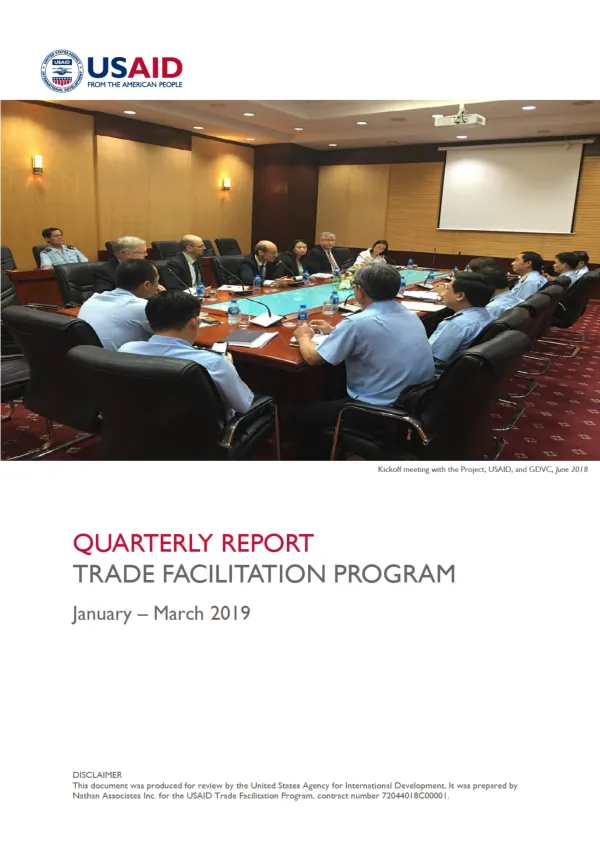
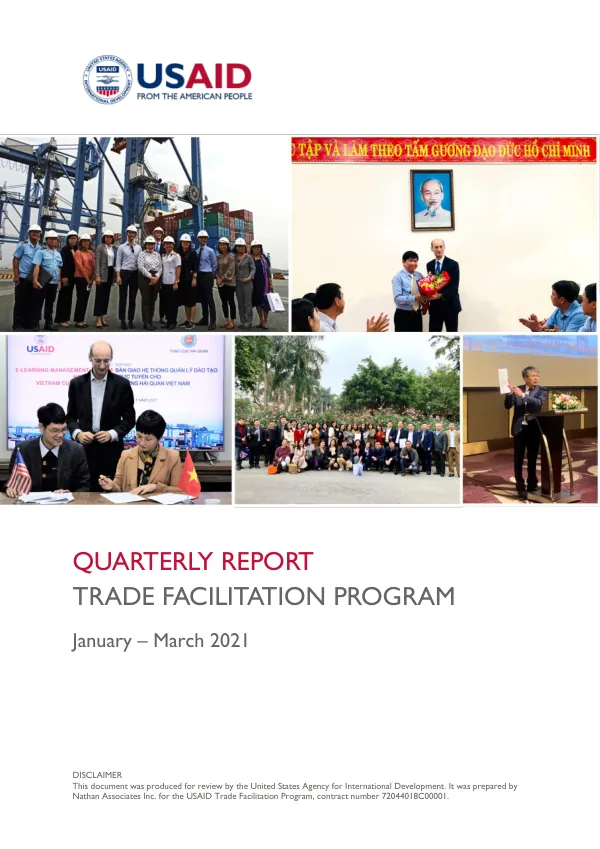
Quarterly Report: Trade Facilitation Program January – March 2021
The USAID Trade Facilitation Program continued to progress towards expediting cross-border trade and improving Vietnam's ability to implement its commitments under the World Trade Organization (WTO) Trade Facilitation Agreement (TFA) in the second quarter (Q2) of 2021.
2021 · 33 pages
Sign in to readA free account is required to download.
Abstract
Despite the challenges posed by the COVID-19 pandemic, the Program implemented most activities planned for Q2 and made headway in institutional reform and streamlining specialized inspection. Activities focused on achieving the "core" areas of the Program. The approval by the Prime Minister of the new "Scheme on Reforming Quality and Food Safety Specialized Inspection (SI) for Imported Goods" is a milestone in the Program's efforts to simplify and harmonize policies and procedures across GVN units. In Q2, the Program supported the General Department of Vietnam Customs (GDVC) to develop the decree to establish the basis of the new SI Scheme, which will sustain the positive momentum for further reforms while ensuring the focus of the Scheme remains on facilitating trade. The new Scheme will lead to institutional reorganization, which will result in greater use of centralized and integrated risk management, offering reduced incidences of inspection, simplified procedures, and reduced clearance time and costs for businesses. At the provincial level, Quang Tri authorities established the Steering Committee on Trade Facilitation based on the Program's recommendations. The Program continued to cooperate with authorities in the five other selected provinces – Hanoi, Hai Phong, Da Nang, Dong Nai, and Ho Chi Minh City - to promote the setup of local trade facilitation mechanisms, like that of Quang Tri. The provincial trade facilitation mechanisms will assist in identifying the challenges faced by the private sector in complying with SI procedures and will act as platforms to deepen dialogue and coordination between local customs, line departments, and businesses on possible solutions to these challenges. On institutional reform, the Program finalized the situational assessment of the National Trade Facilitation Committee (NTFC), which includes recommendations on engaging businesses and reforming the structure of the NTFC. In late March, the Program had the opportunity to discuss the report with Vice Minister (VM) of Finance Vu Thi Mai and GDVC Deputy Director General (DDG) Mai Xuan Thanh. In the long term, a strengthened NTFC and active provincial trade facilitation mechanisms can become catalysts for improved national and provincial coordination and implementation of trade facilitation policies and procedures. The Program also commenced work with the Ministry of Agriculture and Rural Development (MARD) to improve Circular 15/2018, which lists the goods subject to SI under MARD management. The new Circular 15 will identify every product subject to SI under MARD management with a Harmonized System (HS) Code, helping to increase the transparency and predictability of the present system and serving as the basis for promoting the effectiveness of future reforms. The Program also finalized a study assessing the current situation of the Authorized Economic Operator (AEO) program in Vietnam, which includes a section focused on international trends and efforts associated with Mutual Recognition Agreements (MRAs) for AEO programs worldwide. The assessment concluded that compared to other countries, there is justification for GDVC to expand the AEO program. Activities addressing pressing challenges to facilitate trade in the medium-term included the completion of the "Pre-feasibility study on Cat Lai port decongestion plan" and the introduction of the report to stakeholders, including the Ministry of Transport's (MOT) Vietnam Maritime Administration (VINAMARINE) and Inland Waterways Administration (VIWA), and Saigon New Port Corporation (SNP). The study recommended two activities to address the forecasted doubling of the overall container volume currently handled by the system: a larger-capacity container-on-barge system to serve the container transit needs on the river system between Cat Lai and the deep-water Cai Mep port, and the development of a specialized barge terminal in Cai Mep to accommodate an expected surge in container-on-barge requirements. The Program continued to make progress towards its overall purpose and expected intermediate results (IR). In Q2, the Program assessed that Vietnam is on the right track in the implementation of the WTO TFA, as 16 out of 24 measures under categories B and C are in full compliance with eight measures still requiring reform. In Q1 and Q2, the Program supported the implementation of ten WTO TFA provisions, two of which are among the eight measures still requiring reform. In Q2, the Program also actively promoted the simplification and harmonization of policies and procedures across GVN units (IR1) by supporting five key legal acts (four decrees and one circular) that address SI, HS codes, risk management, import-export taxes, and customs procedures. Moreover, the Program continued to create the necessary conditions to strengthen national and provincial coordination (IR2) and implementation (IR3) through the NTFC assessment study and setting up provincial trade facilitation mechanisms.