USAID DEC
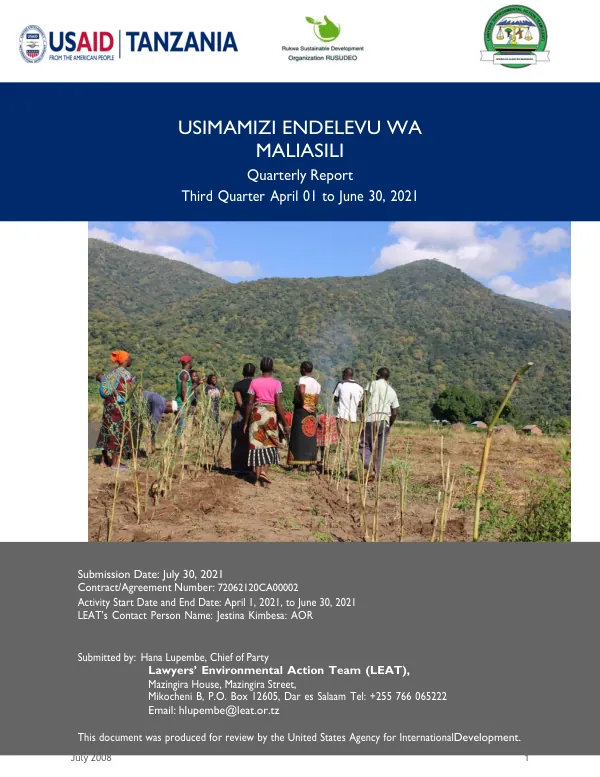
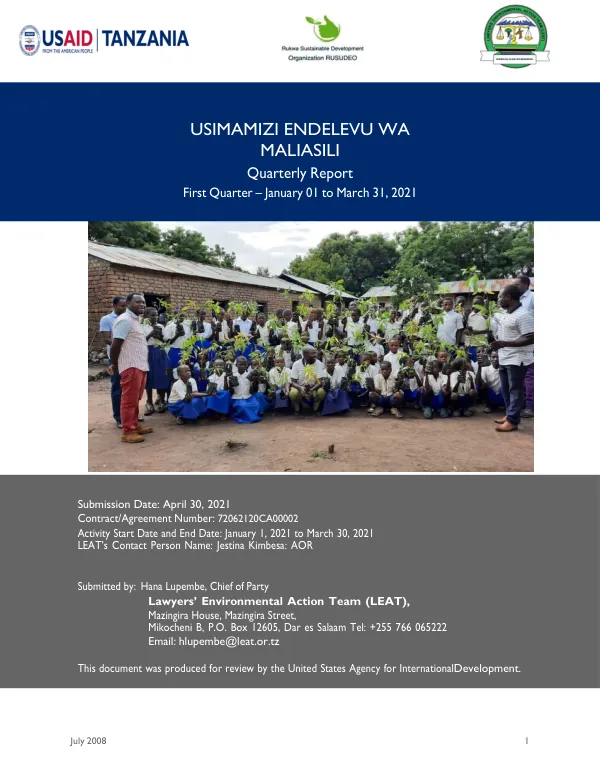
Quarterly Report: Usimamizi Endelevu wa Maliasili (First Quarter – January 01 to March 31, 2021)
Sign inUSAID DEC
Quarterly Report: Usimamizi Endelevu wa Maliasili (First Quarter – January 01 to March 31, 2021)
Usimamizi Endelevu wa Maliasili is a five-year multi-sectoral intervention implemented by Lawyers' Environmental Action Team (LEAT) and Rukwa Sustainable Development Organization (RUSUDEO) in Sumbawanga, Rukwa region.
2021 · 39 pages
Sign in to readA free account is required to download.
Abstract
The activity targets a cluster of 15 villages located in Sumbawanga and Nkasi districts along the Lyamba lya Mfipa hills. The goal of the activity is to conserve biodiversity and build the resilience of communities and ecosystems in Rukwa region through improved governance of natural resources. The activity aims to achieve four specific objectives: to develop and implement inclusive land-use plans, bylaws, and other Natural Resources Management (NRM) governance processes and tools; to improve the capacity of communities to hold institutions entrusted with managing natural resources accountable; to improve the capacity of communities and local government authorities to holistically manage natural resources; and to raise awareness to the community on NRM and governance, Social Accountability Monitoring, and Climate Change through media, theatre for development, and Information Education and Communication (IEC) materials. Usimamizi Endelevu wa Maliasili works to conserve land, wildlife, forests, and water resources and build the resilience of local communities and ecosystems along the Lyamba lya Mfipa hills in Rukwa through improved natural resources governance. The activity selects Lyamba lya Mfipa hills as a site for implementation due to the preciousness and richness of forests, wildlife, water, and land resources that are vulnerable to extraction and exploitation. To realize its objectives, the activity works with a wide range of natural resources management actors at national, regional, district, ward, and village levels to address challenges facing the management of water, land, forestry, and wildlife. The activity collaborates with district councils, ward councilors, village councils, village land councils, village natural resources committees, Community Owned Water Supply Organizations (COWSOs), Water Users' Associations (WUAs), Ward Tribunals (WTs), ward level officers, and district environment, and natural resources officers to address cross-cutting and specific challenges in the management of water, land, forestry, and wildlife resources. During the first quarter of 2021, the Resilient Natural Resources Governance (RNRG) Activity recorded substantial progress across all the Activity Intermediate Results (IRs). For example, under IR 1, LEAT and RUSUDEO conducted trainings that increased land management and governance awareness to 560 (M365:F195) individuals from village councils, land councils, village committees, and villagers. The activity also made progress in improving the capacity of communities to hold institutions entrusted with managing natural resources accountable, improving the capacity of communities and local government authorities to holistically manage natural resources, and raising awareness to the community on NRM and governance, Social Accountability Monitoring, and Climate Change through media, theatre for development, and IEC materials. The activity's progress is a result of its collaboration with various stakeholders, including district councils, ward councilors, village councils, village land councils, village natural resources committees, COWSOs, WUAs, WTs, ward level officers, and district environment, and natural resources officers. The activity's achievements demonstrate its commitment to improving natural resources governance and building the resilience of local communities and ecosystems in Rukwa region. The activity's progress is also reflected in the increase in land management and governance awareness among community members. The trainings conducted by LEAT and RUSUDEO have equipped community members with the knowledge and skills necessary to manage natural resources effectively. The activity's efforts to improve the capacity of communities to hold institutions entrusted with managing natural resources accountable have also led to increased transparency and accountability in natural resources management. Overall, the Usimamizi Endelevu wa Maliasili activity has made significant progress in achieving its objectives and improving natural resources governance in Rukwa region. The activity's collaboration with various stakeholders and its commitment to building the resilience of local communities and ecosystems have contributed to its success.