RTI INTERNATIONAL
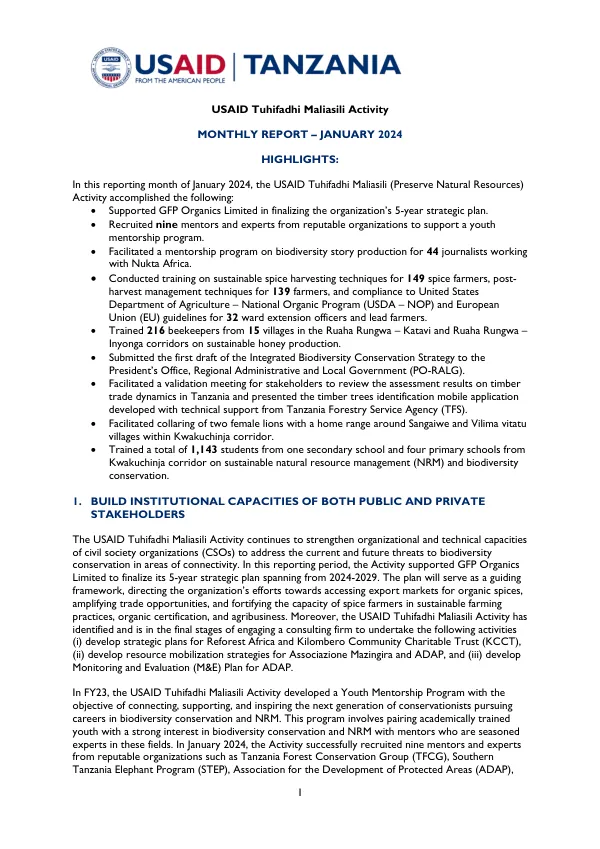
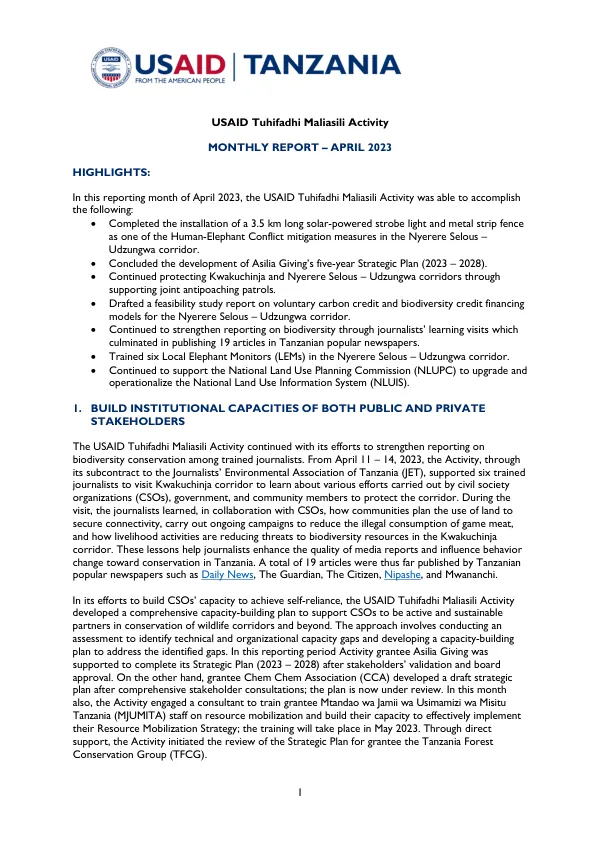
USAID Tuhifadhi Maliasili Monthly Report - November 2021
The USAID Tuhifadhi Maliasili Activity is a conservation initiative aimed at promoting biodiversity conservation and natural resource management in Tanzania.
2021 · 5 pages
Sign in to readA free account is required to download.
Abstract
The activity began in 2021 with the goal of supporting the Tanzanian government in its efforts to conserve and manage the country's natural resources. One of the key objectives of the activity is to build institutional capacities of both public and private stakeholders. To achieve this, the activity has been working with various institutions, including the Tanzania Commission for Science and Technology (COSTECH) and the Tanzania Forest Services (TFS), to develop a data management system for biodiversity conservation. The system aims to collect, store, retrieve, and analyze data to inform decision-making for biodiversity conservation in the country. The activity has also been working to increase private sector engagement in biodiversity conservation and natural resource management. To achieve this, the activity has been conducting a non-conservation value chain analysis and financing models on various value chains in priority areas of connectivity. The analysis aims to identify opportunities and obstacles to conservation and natural resource management in these areas. In addition, the activity has been working to improve the policy, regulatory, and enabling environment for biodiversity conservation and natural resource management. To achieve this, the activity has completed and submitted a draft corridor-level Political Economy Analysis (PEA) report to USAID for review. The report provides detailed analyses and findings on opportunities and obstacles of change in each of the six target areas of connectivity. The activity has also been working to improve cross-cutting issues, including external communication and collaboration, learning, and adapting. To achieve this, the activity has prepared social media updates and shared them with USAID Tanzania Director of Communications and Outreach (DOC). The activity has also translated the English brochure into Kiswahili for non-English speakers and those who prefer Kiswahili over English. Furthermore, the activity has been working to improve monitoring, evaluation, and learning (MEL). To achieve this, the activity's M&E unit conducted training to all the activity's technical team on five key areas, including data flow, Performance Indicator Reference Sheets (PIRS), data collection tools, required backup documentation for collected data, and the Environmental Mitigation and Monitoring Plan (EMMP). The activity has also furnished the Contracting Officer's Representative (COR) with the required information to enable creation of the activity's account on the Development Information Solution (DIS), a web-based platform for all the USAID implementing partners for data entry and results management. The activity has also made progress in submitting reports, including the FY21 Annual Report and the October 2021 progress report. The activity has also participated in an event organized by Society for International Development (SID) Water Environment & Sustainability Workgroup and conducted a refresher training to all technical staff on Collaboration, Learning, and Adapting (CLA) by explaining the activity's learning agenda and its approach. Overall, the USAID Tuhifadhi Maliasili Activity has made significant progress in promoting biodiversity conservation and natural resource management in Tanzania. The activity has been working to build institutional capacities, increase private sector engagement, improve the policy, regulatory, and enabling environment, and improve cross-cutting issues.
Related documents