ACDI/VOCA
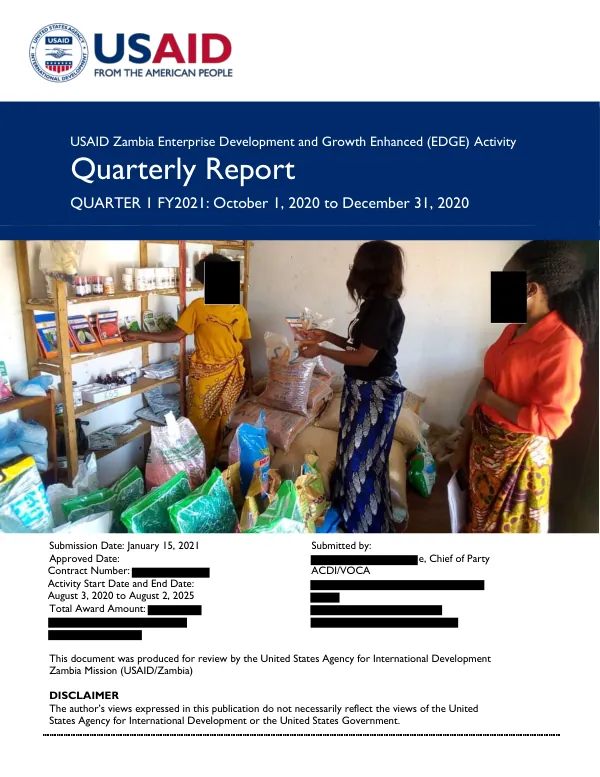
Quarterly Reporting Standard Format for IPs Final
The agricultural sector in Zambia is a key driver of economic growth, contributing approximately 22 percent to the country's Gross Domestic Product (GDP) and providing a livelihood for at least 50 percent of the population.
2021 · 26 pages
Sign in to readA free account is required to download.
Abstract
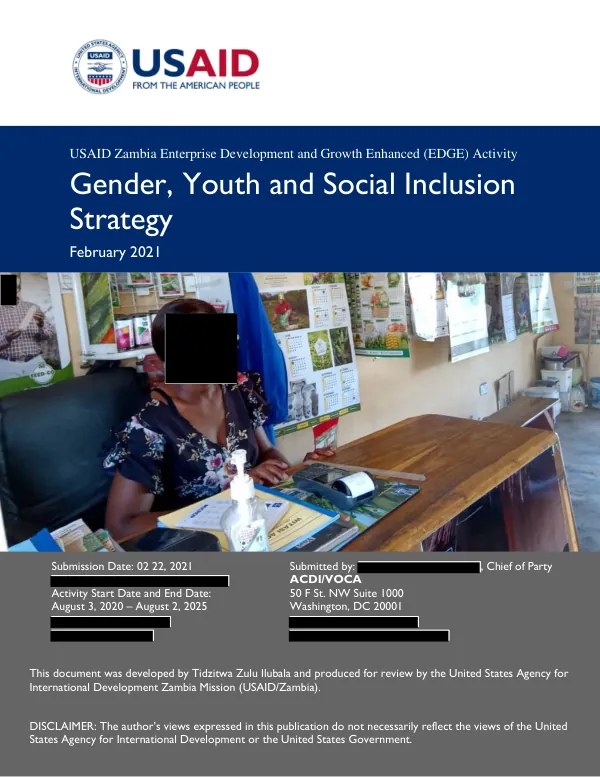
The sector has great potential to create employment and income opportunities for a significant proportion of the population, thereby fostering sustainable economic growth and poverty reduction. With a population comprised of around 51 percent women and 49 percent men, and approximately 74 percent of the population under the age of 30, the sector has a unique opportunity to address the needs of vulnerable groups, including women and youth. The USAID Zambia Enterprise Development and Growth Enhanced (EDGE) Activity is a five-year intervention aimed at creating jobs and increasing the profitability of small- and medium-sized agricultural enterprises (SMEs) in Zambia. The Activity will address the barriers and constraints faced by SMEs, including limited access to finance, lack of business management skills and technology, and limited access to markets. EDGE will utilize a facilitative approach and work closely with local partners to drive lasting systemic changes that create sustainable impact at scale. The Activity has two mutually reinforcing objectives: increased access to finance for agricultural SMEs, including female-owned enterprises, and increased competitiveness for SMEs' products. To achieve these objectives, EDGE will focus on strengthening the ability of banks and microfinance institutions (MFIs) to serve SMEs, catalyzing non-bank financial institutional growth, strengthening SMEs' management and marketing capacities, and improving network input/output relationships. During the life of the Activity, EDGE is expected to support 450 agricultural SMEs, which will generate at least 2,500 full-time positions, including at least 40 percent youth and 30 percent women participants. The GYSI Strategy seeks to close gender and age gaps and advance gender equality throughout EDGE. The Strategy aims to empower Zambian men, women, and youth to succeed as SME owners and employees. To achieve this, EDGE will actively work with local system actors to reduce barriers that women and youth face as owners of SMEs and as employable populations. The Strategy will focus on six value chains, including groundnuts, poultry, animal feed, aquaculture, honey, and horticulture, which show the most promise in terms of inclusiveness, resilience, and competitiveness. The Inclusive Market Systems Development approach will be used to develop market systems around vulnerable populations, including women and youth. EDGE will work with local system actors to reduce barriers that women and youth face as owners of SMEs and as employable populations. The Strategy will also focus on strengthening the ability of banks and MFIs to serve SMEs, catalyzing non-bank financial institutional growth, strengthening SMEs' management and marketing capacities, and improving network input/output relationships. The GYSI Strategy will be implemented through a programmatic approach, which includes Component 1: Increased Access to Finance for Agricultural SMEs, Including Female-Owned Enterprises, and Component 2: Increased Competitiveness for SMEs' Products. The Strategy will also focus on management approach, monitoring, evaluation, and learning, and will utilize the Inclusive Market Systems Development approach to develop market systems around vulnerable populations. The Activity is expected to generate significant economic benefits, including increased profitability for agricultural SMEs, improved job creation, and increased participation of women, men, and youth in the interventions. The GYSI Strategy will play a critical role in achieving these objectives and ensuring that women, men, and youth participate in and benefit from the interventions.