USAID DEC
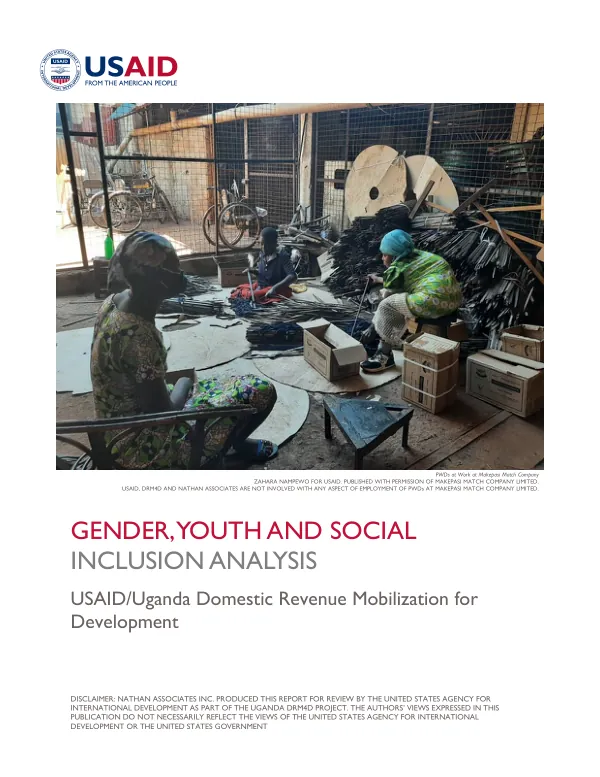
Gender, Youth and Social Inclusion Analysis for the USAID/Uganda Domestic Revenue Mobilization for Development (DRM4D) Activity
Sign inROBERT NATHAN ASSOCIATES
Gender, Youth and Social Inclusion Analysis for the USAID/Uganda Domestic Revenue Mobilization for Development (DRM4D) Activity
The study on gender, youth, and social inclusion analysis in Uganda's Domestic Revenue Mobilization for Development (DRM4D) project was conducted to examine the dynamics of domestic revenue generation in Uganda, with a focus on how interventions through the DRM4D Activity could affect men and women, youth, and Persons with Disabilities (PWDs).
2021 · 97 pages
Sign in to readA free account is required to download.
Abstract
The study utilized a desk review and a five-week field mission to collect qualitative data through semi-structured interviews with key informants at the national, district, and community levels, as well as through Focus Group Discussions (FGDs) with community members in three cities: Kampala, Jinja, and Fort Portal. The study applied two analytical frameworks: the Harvard Analytical Framework and the Positive Youth Development (PYD) Framework. The Harvard Analytical Framework was used to examine role allocation between men and women, access and control of resources, and factors that influence gender differences in the first two profiles. The PYD Framework was used to examine four main domains affecting youth participation: access to necessary assets, agency to influence their own decisions, contribution to community development, and existence of an enabling environment. Regarding marginalized groups, a four-question approach was applied to determine reasons for and forms of exclusion from DRM, as well as their challenges and fears. The study found that the impact of taxation and fiscal policies on marginalized women, youth, and other groups is visible in both direct and indirect taxes. Direct taxes bring out glaring inequalities in employment, with women, men, youth, and PWDs having different gender- and age-defined economic and social roles and practices dictated by culture and social norms. These roles affect their decisions on whether and how much to work, the nature of work, and personal consumption habits, therefore having a direct correlation to DRM. For instance, more men than women are employed in higher-paying work, and the gender gap in earnings is also fueled by discriminatory norms that deny women equal pay for work of equal value. The majority of youth and PWDs are often unemployed, which has resulted in an exodus of many Ugandan youth to the Middle East to seek alternative employment opportunities. The study also found that the differences in income between men and women, youth, and PWDs have a significant impact on their ability to participate in DRM. Women, youth, and PWDs have limited access to resources, such as education, healthcare, and financial services, which hinders their ability to participate in the formal economy and contribute to DRM. The study recommends that the DRM4D Activity should prioritize the integration of gender, youth, and social inclusion into its programming to address these inequalities and ensure that marginalized groups have equal access to resources and opportunities. The study also highlights the importance of enhancing public-private dialogue on DRM to ensure that the needs and concerns of marginalized groups are taken into account. The study recommends that the DRM4D Activity should work with civil society organizations and other stakeholders to promote public-private dialogue and ensure that the needs and concerns of marginalized groups are addressed. In terms of improving tax policy and broadening the tax base, the study recommends that the DRM4D Activity should prioritize the development of policies that address the needs and concerns of marginalized groups. This includes the development of policies that promote equal pay for work of equal value, provide access to education and healthcare, and ensure that marginalized groups have equal access to financial services. The study also recommends that the DRM4D Activity should work to improve tax and non-tax revenue administration and compliance, particularly for marginalized groups. This includes the development of policies and procedures that ensure that marginalized groups have equal access to tax services and are not disproportionately affected by tax compliance procedures. Overall, the study highlights the importance of integrating gender, youth, and social inclusion into DRM programming to address the inequalities and challenges faced by marginalized groups. The study provides recommendations for the DRM4D Activity to prioritize the integration of gender, youth, and social inclusion into its programming and to work with civil society organizations and other stakeholders to promote public-private dialogue and ensure that the needs and concerns of marginalized groups are addressed.