MASSACHUSETTS INSTITUTE OF TECHNOLOGY
Radio broadcasting and telecommunications in Nepal
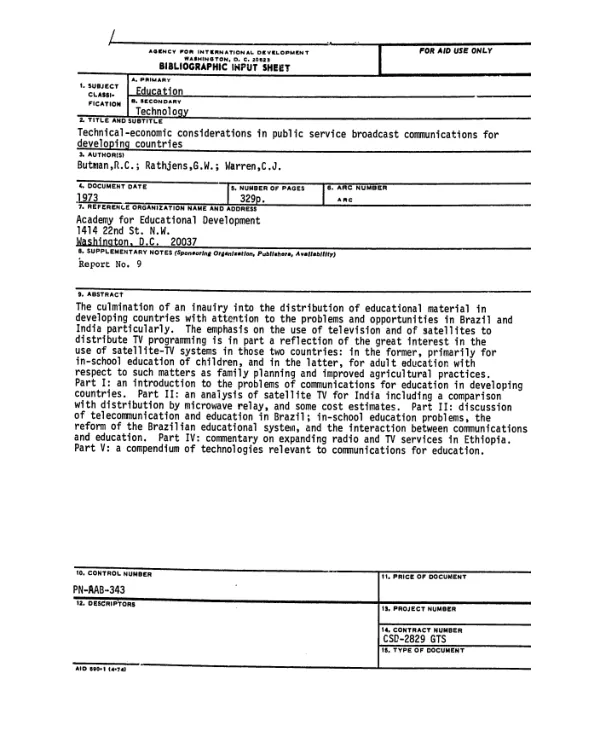
In previous studies the authors considered the possible use of television for educational purposes in Brazil and India and, in a very cursory way, of radio and television in Ethiopia.
Rathjens, G. W.; Butman, R. C. +1 more · 1970
Sign in to readA free account is required to download.
Abstract
The analyses focused entirely on the means of delivering "the message" to the television or radio receiver, e.g., by satellite, terrestrial microwave links, physical delivery of film or tapes, etc. without making judgments as to whether or not television, or radio, would be effective, and in particular cost-effective, as a medium for instruction, either in the schools or for adult education. They felt that those analyses, and others of a similar nature, were inadequate in that they focused on the question of communications for education in isolation, failing to treat adequately the possibility that the same communications links might be used with benefit not just for education but for a number of purposes, indeed, with educational radio or TV often being a secondary user. This led them in this study and in a companion document to consider the question of communication from a broader perspective as they extended their studies to Nepal and Indonesia. The discussion of problems and possibilities in the case of Nepal is somewhat arbitrarily divided into three parts: radio broadcast services generally, radio for education in the schools, and two-way telecommunications. They have not treated the possibility of television, feeling that the costs, difficulties of maintenance, and problems of power supply make it unrealistic at this time as a communications medium for Nepal, except possibly for the Kathmando Valley. Neither have they concerned themselves with the problems of mail and newspaper distribution. Their analysis is based largely on information obtained during a visit to Nepal in late May-early June 1974.
![Egypt telecommunications master plan II : volume 3 -- recommendations & voice over IP [internet telephony] update](https://covers.devme.ai/gen/23376.webp)