DAI
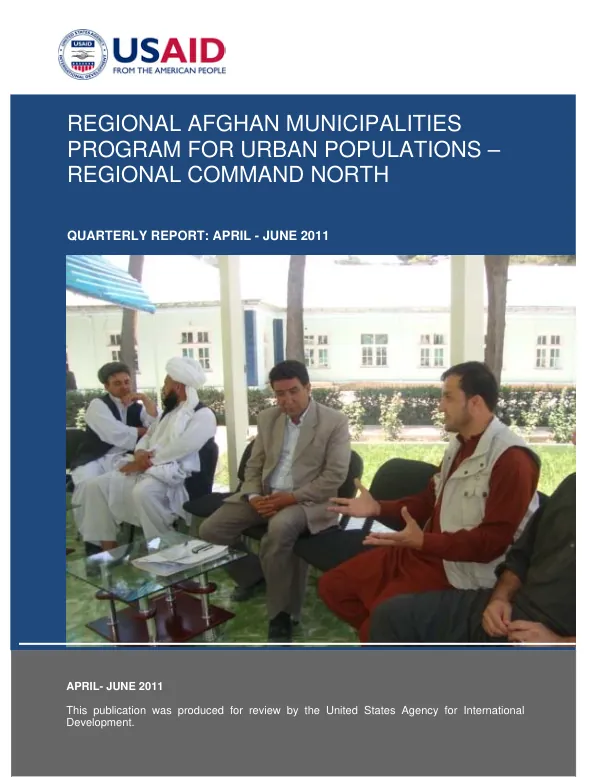
RAMP-UP NORTH QUARTERLY REPORT
Regional Afghan Municipalities Program for Urban Populations – Regional Command North (RAMP UP North) was awarded on January 27, 2011, with project mobilization authorized on March 17, 2011, due to President Karzai's Private Security Company (PSC) Decree.
2011 · 13 pages
Sign in to readA free account is required to download.
Abstract
The project's Chief of Party (COP) arrived in-country in mid-May and devoted the remainder of the reporting period (Q3) to start-up activities, including negotiating office and residential lease arrangements, recruiting and deploying key international technical and operations staff, and recruiting and employing key CCN staff. Municipal progress highlights during the latter part of the quarter included meetings with local municipal officials to introduce the project and its key objectives and activities. These meetings took place in Mazar-e-Sharif, Samangan Province, and Sheberghan, with municipal officials identifying priority needs such as solid waste collection improvements, drainage improvements, and street lighting. RAMP UP North's primary Assistance Objective (AO) is "improved performance and accountability of governance." The program aims to increase the capacity of GIRoA municipal officials, markedly improve the delivery of municipal services to citizens in target municipalities, and increase municipal capacity to enable, support, and sustain economic growth. The RAMP UP North development proposition is that, as a result of achieving these objectives, Afghan citizens will see local governance structures as legitimate. RAMP UP North's Performance Management Plan (PMP) specifies how the program measures the outputs and outcomes of its activities. The program uses 13 complimentary indicators to measure ongoing progress and support impact measurements. Baseline assessment activities for some indicators will be conducted in the next quarter (Q4). The program's development proposition is tied to receiving better services, understanding the responsibilities of municipal leaders, and playing an active role in municipal decision making. Delivery of essential services to citizens and businesses will foster a stronger revenue base more likely to comply with taxation requirements, generating greater revenues that enable a government to progressively expand and improve services. RAMP UP North's Intermediate Results (IRs) and Contract Line Item Numbers (CLINs) structure can be understood as three overlapping means of measuring how effective the program is in partnering with various municipal government and community stakeholders to contribute to increased legitimacy of GIRoA partners. The program's impact measurements will be tabulated on an annual basis, with ongoing progress measured through 13 complimentary indicators. The following indicators are used to measure the program's progress: Indicator A.O. 1.1, "% increase in citizen satisfaction with municipal government," which aims for a 20% increase in citizen satisfaction. Baseline assessment activities for this indicator will be conducted in the next quarter (Q4).