DAI
RAMP UP Performance Monitoring Plan
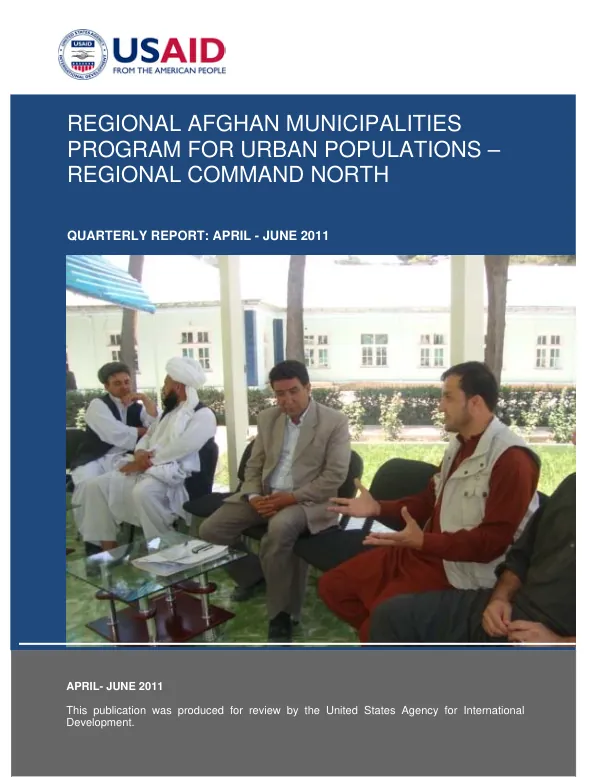
Regional Afghan Municipalities Program for Urban Populations (RAMP UP North) was awarded to DAI on January 27, 2011, with the purpose of creating effective, responsive, democratic, transparent, accountable, and gender-sensitive municipal governance in the nine provinces of International Security Assistance Force's (ISAF) Regional Command North (RC-N).
2011 · 47 pages
Sign in to readA free account is required to download.
Abstract
The project was designed to enhance the capacity of municipal officials, managers, and technicians to perform their core municipal management responsibilities. RAMP UP North activities are broken into three components, each labeled as a distinct Contract Line Item Number (CLIN). CLIN 1 focuses on Capacity Building of GIRoA officials at the municipal level, providing on-the-job mentorship, training, and advising to enable more visible, responsive, and accountable governance. CLIN 2 supports the GIRoA to provide responsive, effective, and visible municipal service delivery programs, including Service Delivery Improvement Projects (SDIPs) that fill two purposes: improving daily life for citizens and building capacity with a clear learning-by-doing approach. CLIN 3 supports the GIRoA to improve economic development and revenue generation at the municipal level, using capacity and service improvements to facilitate business growth and job creation. RAMP UP North's primary objective is to create an effective, responsive, democratic, transparent, accountable, and gender-sensitive municipal governance in the nine provinces of ISAF's Regional Command North. This objective feeds into the USAID/Afghanistan Assistance Objective 1: Improved Performance and Accountability of Governance. The project will achieve this objective through its three Intermediate Results, each corresponding to one CLIN: (a) Increased Capacity of GIRoA Municipal Institutions; (b) Improved Delivery of Municipal Services to Citizens in Targeted Municipalities; and (c) Increased Municipal Capacity to Enable, Support, and Sustain Economic Growth. RAMP UP North measures its impact on the project level in terms of the number of citizens who indicate confidence and trust in municipal government, improvement in provision of services, and feel included in municipal decision-making. Intermediate results are being measured through a combination of output and outcome indicators. The project level impact indicators include the percentage of civil society and business representatives who state that their municipality is providing acceptable or better quality of public services, rate the performance of municipal officials in communicating with them as acceptable or better, and rate the performance of municipal officials in including them in decision-making as acceptable or better. RAMP UP North's CLIN structure can be understood as three overlapping Intermediate Results that measure how effective the project is in partnering with various municipal government and community stakeholders to contribute to increased legitimacy of GIRoA partners. The project will measure its Intermediate Results through a combination of output and outcome indicators, including the number of municipal officials trained, the number of Service Delivery Improvement Projects (SDIPs) implemented, and the increase in municipal revenue generation. The project's Performance Management Plan (PMP) specifies how RAMP UP North measures the outputs and outcomes of its activities. The PMP has adapted indicators that monitor performance and evaluate the project's progress toward achieving its objectives. The project will use these indicators to assess its impact and make adjustments to its activities as needed.
![Assistance to Legislative Bodies of Afghanistan (ALBA) [Performance Monitoring and Evaluation Plan]](https://covers.devme.ai/gen/155658.webp)