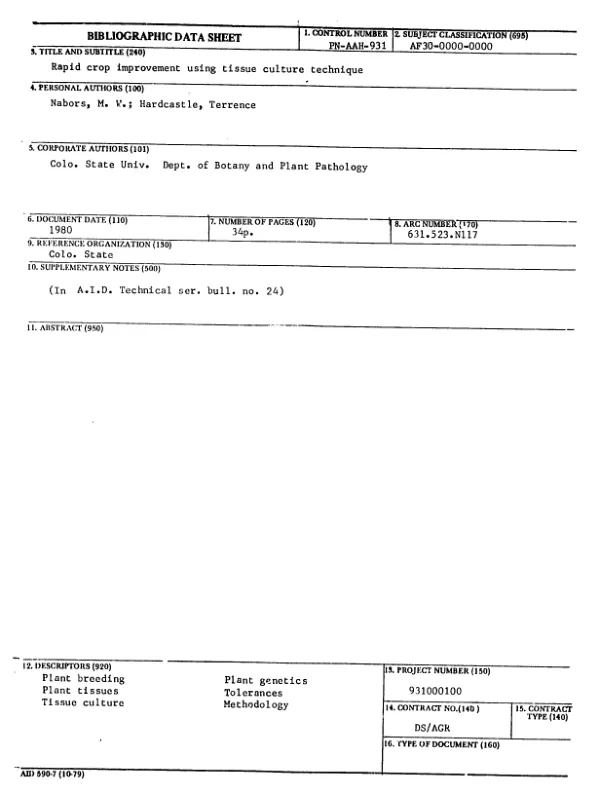
COLORADO STATE UNIVERSITY. DEPT. OF BOTANY AND PLANT PATHOLOGY
RAPID CROP IMPROVEMENT USING TISSUE CULTURE TECHNIQUE
Cell tissue culture techniques used primarily in basic scientific research can now be used to greatly improve plant breeding by rapidly cloning rare, useful plants and by adding new, beneficial alleles to existing crop varieties.
NABORS, M. W.; HARDCASTLE, TERRENCE · 1970
Sign in to readA free account is required to download.
Abstract
Cell tissue breeding will enable new crop varieties to resist specific environmental pressures, surpass the yield of unadapted varieties, and consume less energy. This report discusses the potential of cell tissue culture techniques and details the application of specific methods used to select salt-tolerant plants. Cell culture techniques arrange the mutation and natural selection process into a format that is simpler, better controlled, and more economical than the traditional lengthy and random evolutionary breeding mechanisms. Mutant plant production by this technique consists of four steps: (1) Plant cell groups are placed in a medium with nutrients and special hormones to produce an undifferentiated cell mass or primary callus. Callus portions are placed in a liquid gyrotory shaker to separate single cells from cell clumps, a process known as cell suspension. Single cell suspensions are subcultured when cell density reaches maximum value. (2) Specific spontaneous cell mutations are selected through suspension exposure to conditions that favor mutant growth. Thus, an entire culture of salt-tolerant cells was produced in several months. (3) Mutant cells are induced to grow roots and shoots for eventual regeneration into whole plants (a 4-6 week process). (4) After complete plantlets have been formed, they are transferred to a controlled greenhouse environment for testing of phenotype persistance and mutation inheritability. Most regenerated plants arise from one cell and are thus likely to carry the desired phenotype, if selection occurred in the suspension culture. To avoid deleterious mutations, however, spontaneous mutant searches should be conducted before mutation induction. Although tissue culture methodology is incomplete for some major crops, such as soybeans, techniques are complete for immediate incorporation into existing breeding programs for wheat, oats, corn, tomatoes, and barley. Appended is a nine-item bibliography (1965-80).