USAID DEC
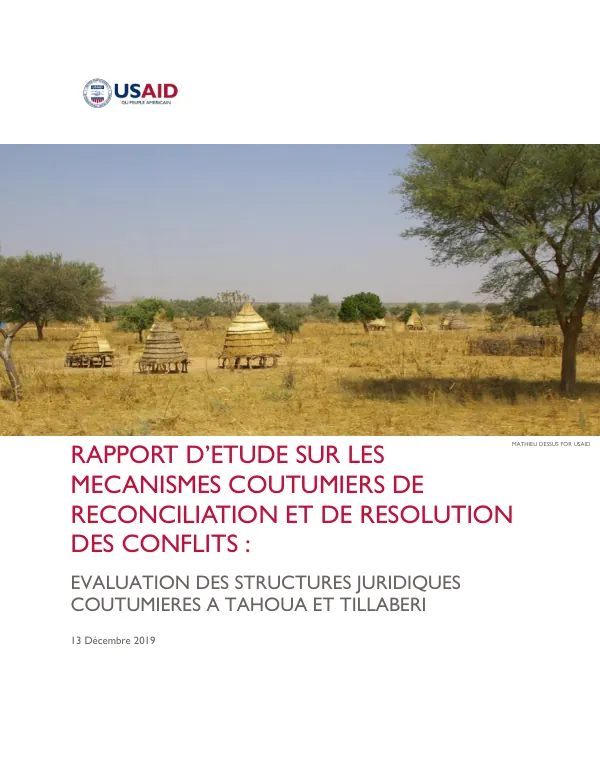
Rapport d'étude sur les mécanismes coutumiers de réconciliation et de résolution des conflits : Évaluation des structures juridiques coutumières à Tahoua et Tillabéri
Sign inINTERNATIONAL BUSINESS AND TECHNICAL CONSULTANTS, INC.
Rapport d'étude sur les mécanismes coutumiers de réconciliation et de résolution des conflits : Évaluation des structures juridiques coutumières à Tahoua et Tillabéri
In the Niger region of Tahoua and Tillabéri, customary mechanisms for conflict resolution and dispute settlement are being evaluated.
2019 · 55 pages
Sign in to readA free account is required to download.
Abstract
The study aims to strengthen non-violent conflict management systems in Africa, with a focus on the regions of Tahoua and Tillabéri. The study's findings will contribute to the design of the "Renforcement des capacités" component of the project, which aims to strengthen customary conflict resolution mechanisms in targeted areas of Tillabéri and Tahoua. A team of researchers, including a socio-economic expert and two magistrates, conducted an in-depth investigation, traveling over 10,000 km and conducting over 100 interviews in two weeks. The study's methodology consisted of a literature review to better understand the study's problem and provide answers to the first question. The team also conducted in-depth interviews with 84 key individuals from 17 departments in the regions of Tahoua and Tillabéri. The study identified two main groups of modern actors: Acteurs Modernes Centraux (AMC), composed of governors, prefects, and judges, and Néo-Acteurs Modernes (NAM), including local elected officials and representatives of organized civil society. The study highlights the importance of customary conflict resolution mechanisms in the regions of Tahoua and Tillabéri, and the need to strengthen these mechanisms to prevent and manage conflicts. The customary conflict resolution mechanisms in the regions of Tahoua and Tillabéri are based on traditional models, with a focus on mediation and arbitration. The study found that the customary conflict resolution mechanisms are effective in resolving conflicts, but are often limited by a lack of resources and infrastructure. The study recommends strengthening the customary conflict resolution mechanisms by providing training and resources to traditional leaders, and by promoting dialogue and cooperation between traditional and modern actors. The study also highlights the importance of addressing the root causes of conflicts, including land disputes and competition for resources. The study recommends that the project focus on addressing these underlying issues, and that it work to build the capacity of traditional leaders to manage conflicts and promote peace and stability in the regions of Tahoua and Tillabéri. The study's findings and recommendations will contribute to the design of the project's "Renforcement des capacités" component, and will inform the development of the project's "Amélioration de l'accès aux mécanismes coutumiers de résolution des conflits" component. The study's results will also inform the development of policies and programs aimed at promoting peace and stability in the regions of Tahoua and Tillabéri.