ABT ASSOCIATES
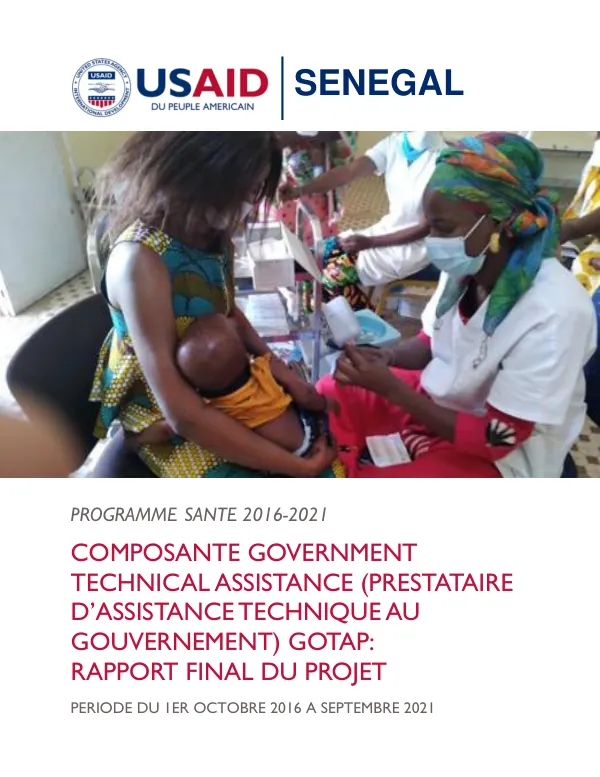
Rapport Final du Projet GOTAP
The Government Technical Assistance Provider (GoTAP) program in Senegal was a five-year initiative aimed at supporting the government in improving the country's health sector.
2021 · 56 pages
Sign in to readA free account is required to download.
Abstract
The program was managed by Abt Associates, Inc. in collaboration with Africa Resources Group, Association Conseil pour l'Action, and Training Resources Group, Inc. The project was funded by the United States Agency for International Development (USAID) under contract numbers AID-OAA-I-14-00032 and AID-685-TO-16-00002. The program's primary objective was to enhance the capacity of the Ministry of Health to manage and implement the Global Health Security Agenda (GHSA) and the President's Malaria Initiative (PMI). To achieve this goal, the program focused on five key tasks: (1) ensuring the conformity of the G2G mechanism with USAID's requirements and respecting the procedures of the Government of Senegal, (2) reinforcing the role of the Ministry of Health in the G2G financing of USAID, (3) conserving benefits for health through technical assistance at the demand or need, (4) reinforcing local capacity for result-based management, and (5) reinforcing communications on the use of data to improve USAID programs. The program's implementation was divided into several components, including the development of a G2G mechanism, the establishment of a committee of pilotage, and the implementation of a system for tracking and evaluating the program's progress. The program also focused on strengthening the capacity of local health authorities to manage and implement health programs, as well as improving the use of data to inform decision-making. Throughout the five-year period, the program made significant progress in achieving its objectives. The G2G mechanism was successfully established, and the Ministry of Health was able to take a more active role in managing the program. The program also made significant gains in reducing the incidence of malaria, with a 27% reduction in the number of cases reported in the three regions where the program was implemented. The program's success was also reflected in the improvement of health indicators in the three regions, including a 25% increase in the number of health facilities equipped with essential medical supplies and a 30% increase in the number of health workers trained in malaria diagnosis and treatment. The program also made significant progress in strengthening the capacity of local health authorities, with a 50% increase in the number of health authorities trained in result-based management. The program's achievements were also recognized by the Government of Senegal, which acknowledged the program's contribution to the improvement of the country's health sector. The program's success was also recognized by USAID, which praised the program's innovative approach to improving health outcomes in Senegal. In conclusion, the GoTAP program in Senegal was a highly successful initiative that made significant contributions to the improvement of the country's health sector. The program's achievements were reflected in the improvement of health indicators, the strengthening of local capacity, and the establishment of a G2G mechanism that will continue to support the country's health sector in the years to come. The program's implementation was divided into several components, including the development of a G2G mechanism, the establishment of a committee of pilotage, and the implementation of a system for tracking and