USAID DEC
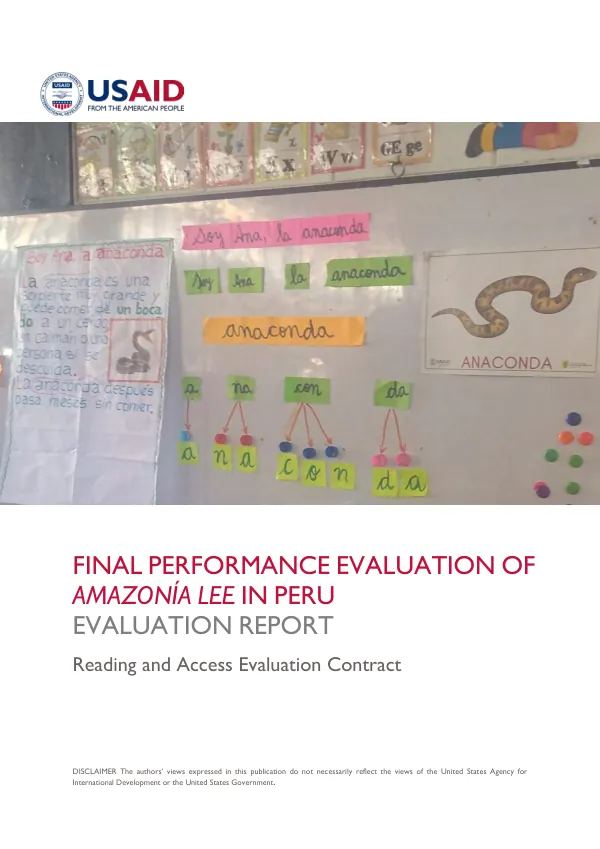
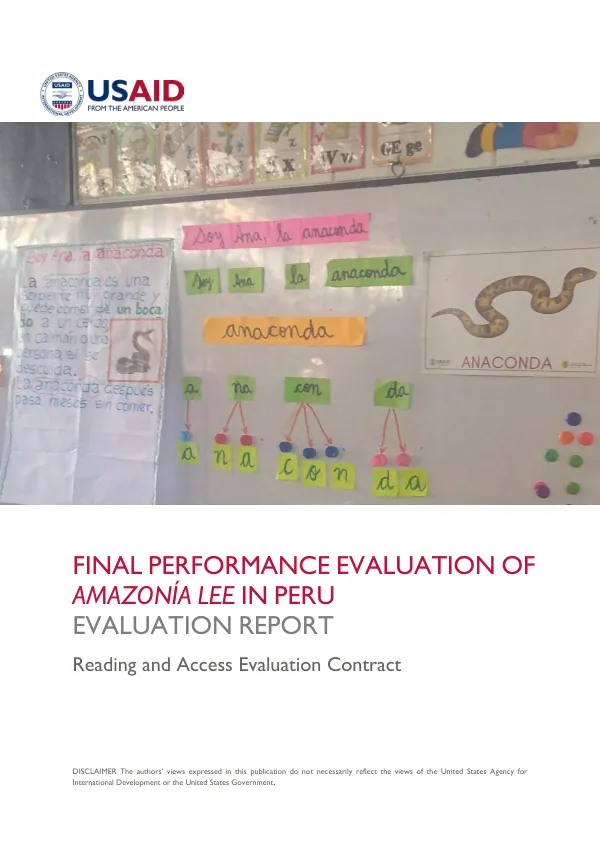
Reading and access evaluation report : final performance evaluation of Amazonia lee in Peru
Sign inNORC AT THE UNIVERSITY OF CHICAGO
Reading and access evaluation report : final performance evaluation of Amazonia lee in Peru
The purpose of this performance evaluation is to assess the applicability, replicability, and sustainability of key components of the Amazonía Lee project in Peru.
Alvarado de Lozin, Betty|Rojas Arellano, Ingrid|Mark, Katharine|Martínez, Carla
Sign in to readA free account is required to download.
Abstract
Amazonía Lee was designed to improve early grade reading performance and address the learning gaps of two Amazonian regions in Peru. The project was implemented by the Regional Education Directorates (Direcciones Regionales de Educacion, DREs) of San Martín and Ucayali starting in 2015 with technical support from the Universidad Peruana Cayetano Heredia (UPCH) and with funding from the United States Agency for International Development (USAID). The performance evaluation sought to answer the following evaluation questions, each with several sub-questions: 1) How applicable is Amazonía Lee to other Amazonian regions of Peru? 2) How can applicable components of Amazonía Lee be replicated in other Amazonian regions of Peru? 3) To what extent are the applicable and/or key components of Amazonía Lee sustainable? The Evaluation Team reviewed documents, analyzed quantitative data, and conducted Key Informant Interviews, Focus Group Discussions, and school visits, including classroom observation and rapid teacher surveys. Amazonía Lee’s outcomes and costs are compared with those of a similar project, Soporte Pedagógico, implemented by the Ministry of Education from 2014 to 2018. Soporte Pedagógico is more cost-effective than Amazonía Lee in schools in Ucayali, and both projects are similarly cost-effective in San Martín, based on the costs per student and student performance on the Students’ Census Evaluation (Evaluación Censal de Estudiantes, ECE). However, some of the elements and approaches of Amazonía Lee are applicable to other Amazonian regions. In particular, the findings indicate the value of incorporating phonetic awareness when teaching children to read, especially in remote or poor areas, and the importance of having sufficient, qualified coaches and contextualized educational materials when replicating the project.
Related documents