USAID. BUR. FOR POLICY AND PROGRAM COORDINATION. CENTER FOR DEVELOPMENT INFORMATION AND EVALUATION (CDIE)
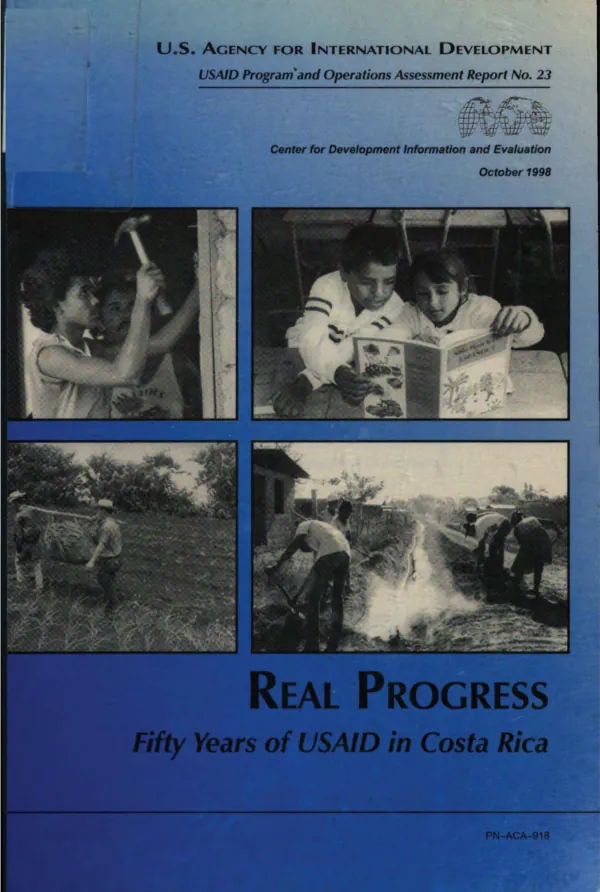
Real progress : fifty years of USAID in Costa Rica
This report assesses the impact of the $2 billion provided to Costa Rica by the U.S.
Fox, James W. · 1998
Sign in to readA free account is required to download.
Abstract
government over the past 50 years. First, the report provides an overview of Costa Rica from 1945 to 1995, both in macroeconomic terms and by examining how life changed in two rural communities between 1950 and 1995. Next, the study assesses the four broad conceptual approaches used by USAID in Costa Rica (and elsewhere): technical assistance (pre-1961), "high development" (the Alliance for Progress -- 1961-72), basic human needs and poverty reduction (1972-81), and economic restructuring and reactivation (1982-92). Concluding sections assess the effectiveness of USAID assistance, identify particular successes and failures, and present lessons learned. The report concludes that U.S. economic assistance significantly contributed to Costa Rican welfare. Costa Ricans are healthier, wealthier, and better educated than they would have been without U.S. assistance. Income distribution is more equal and the country"s environmental base is maintained better than would have been the case without U.S. assistance. Early TA and training were key factors, establishing collaborative relationships between Costa Ricans and Americans and speeding the flow of ideas critical to building the capacity of Costa Rican institutions to deliver basic services and increase economic productivity. Notable successes included: the Inter-American Highway, agricultural technical assistance, health projects, export promotion, scholarships, and structural adjustment. Assistance to Costa Rica also met U.S. foreign policy goals. Costa Rica continues as a vibrant democracy with respect for human rights, a model for other countries. After a rocky period in the early 1980s, its economy has successfully adapted to a changed world economy. It is also a world leader in ecosystem management. If all developing countries had matched Costa Rica"s progress, there would be fewer complaints about the effectiveness of foreign aid. The assessment is even more strongly positive with respect to the large-scale assistance provided during the 1980s. Costa Rica used these U.S. resources effectively, and its leaders, notably then-president Arias, took the lead in formulating an approach that restored peace to Central America. Lessons learned are as follows: (1) Foreign aid can work, especially in the collaborative atmosphere that is perhaps the key characteristic of U.S. aid to Costa Rica. (2) Lack of understanding of the development process flawed the high development and basic needs programs. Two particular problems stand out -- ignorance of government (as distinct from market) failure and of the key role of markets, particularly international trade, in promoting efficiency. (3) USAID"s comparative advantage is due in substantial part to the trust that USAID personnel, on the basis of their in-country experience, were able to engender in host country officials. (4) Poverty reduction efforts of the late 1970s proved counterproductive due to the unsustainability of host government policies. (5) Despite the relatively favorable atmosphere, institution building proved more difficult than expected. (6) USAID"s desire to build on its successes in export promotion in the 1980s resulted in an institution too dependent on continued USAID resources. This lesson probably applies to the entire USAID local currency program. (7) Although it looked like a success in 1970, Costa Rica"s participation in the Central American Common Market actually hindered the country"s growth. (8) Costa Rica is the most successful case of structural adjustment in Central America, though this may be due not just to USAID"s comparative advantage in policy reform, but also to the high level of U.S. assistance during the 1980s. (9) The Costa Rican experience supports the hypothesis of Douglass North that economic development depends on efficient and flexible institutions and procedures, as well as on correct economic policies. Dialogue by USAID with Costa Rican intellectuals and politicians, particularly during the last two decades, has done much to change the way Costa Ricans perceive their prospects and adapt to a changing world environment. Includes bibliography.
Related documents