USAID DEC
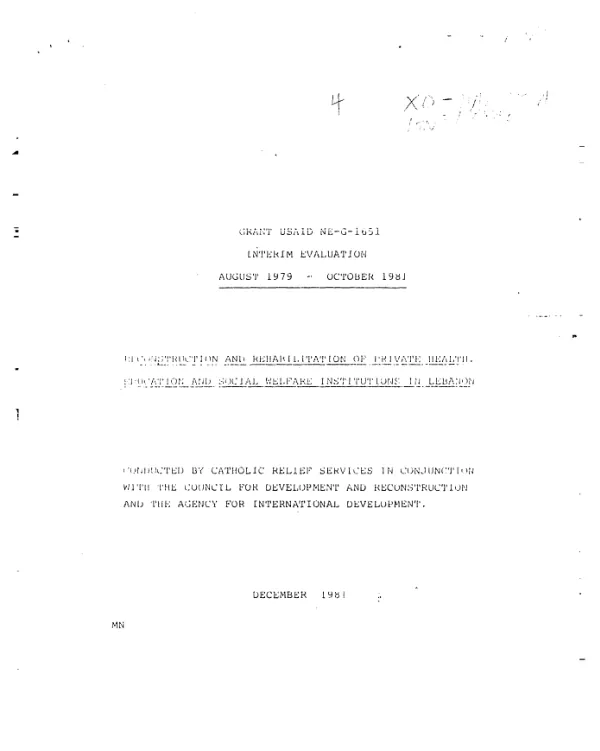
Reconstruction and rehabilitation of private health, education and social welfare institutions in Lebanon; interim evaluation
Sign inCATHOLIC RELIEF SERVICES (CRS)
Reconstruction and rehabilitation of private health, education and social welfare institutions in Lebanon; interim evaluation
Evaluates Catholic Relief Services (CRS) project to rehabilitate social service institutions damaged in the Lebanese civil war.
1981
Sign in to readA free account is required to download.
Abstract
Special evaluation covers the period 8/79-10/81 and was prepared by CRS/Beirut, USAID/L, and Lebanon's Council for Development and Reconstruction (CDR) on the basis of beneficiary questionnaires. To date, LBP 16.5 million has been allocated for 20 mostly large and operational sub-projects chosen out of 86 candidates by the CRS/CDR Selection Committee; of this amount, LBP 15.6 million has been committed to 19 institutions and LL 9.9 million disbursed to 14. Overall, funds were allocated equitably among Lebanon's religious and ethnic groups on the basis of their proportion of the total population, although need remained the supreme criterion. Allocation was higher than numerical representation in the case of Roman and Greek Catholics, but these groups are minorities who tend to serve majority sects, a fact which also helps explain why individual beneficiaries at the 15 institutions sampled were 65.4% non-Christian. Allocation was also equitable geographically, although the Beka'a Valley may have been neglected. The evaluators did not raise the question of political balance among beneficiaries. Allocation of funds to 17% of the LBP 90 million in requests generated by the nationwide publicizing of the project seems to reveal identifiable progress in restoring private institutional services, but this inference is weakened by the lack of accurate data on damage, the damage caused by ongoing strife, and the high recurrent costs of institutions which have large debts to service. The list of institutions, the accuracy of which was an important project assumption, proved inaccurate. CRS has mobilized LBP 11.8 million (U.S. $2.9 million) in non-AID funds for the 12 subprojects already completed (a figure expected to increase to LBP 22.2 million for the project as a whole) and has provided other important inputs such as bringing similar institutions together. Security and the depreciation of the U.S. dollar have been the main factors impeding the project. Most funds (61%) have been allocated for schools, but little has been done in the areas of mental health and physical rehabilitation. The Selection Committe should discuss the issue, untouched in the grant criteria, of allocation by sector.