USAID DEC
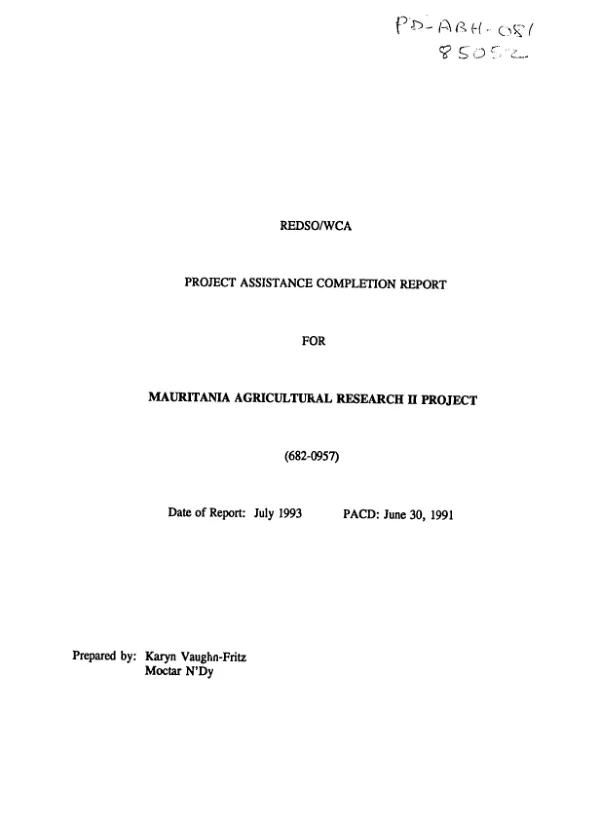
REDSO/WCA project assistance completion report for Mauritania agricultural research II project (682-0957)
Sign inUSAID. BUR. FOR AFRICA. REGIONAL ECONOMIC DEVELOPMENT SERVICES OFC. (REDSO) WEST AND CENTRAL AFRICA
REDSO/WCA project assistance completion report for Mauritania agricultural research II project (682-0957)
PACR of a project (8/84-6/91) to strengthen the National Agricultural Research Center (CNRADA) in Kaedi, Mauritania, as part of a regional effort to upgrade agricultural research in the Senegal River Valley.
Vaughn-Fritz, Karyn|N'Dy, Moctar · 1993
Sign in to readA free account is required to download.
Abstract
The project was implemented by the Ministry of Rural Development. The project made considerable progress in strengthening Mauritania's agricultural research capacity at a critical time. Recent droughts had hindered crop and livestock production and the country had an immediate need to increase production in a sustainable way without reliance on large government subsidies. Specific activities included the following. (1) A 5-year National Research Plan, based on a farming systems research approach, was created; the plan lays a strong foundation for future progress. (2) Numerous reconnaissance and thematic studies and surveys provided useful data on farming systems in the region; 14 farming systems surveys were completed, 2 promising sorghum varieties were identified, a germplasm collection was established, sesame was tested as a cash crop, and 13 additional studies yielded data on ecology, technology, food consumption, nutrition, and women. CNRADA staff conducted the research, with guidance from the TA team. However, on-station and on-farm tests of rainfed and recessional grain crops did not produce the desired results, due probably to poor planning and inadequate funding. Most of the tests were never completed. (3) Seven of CNRADA's top researchers received B.S. or M.S. training at the University of Arizona, and short-term training (in-country and third-country) was provided to other researchers and research assistants. Other training included active participation of CNRADA personnel and researchers in international conferences; word processing training for secretaries; and on-the-job training in surveying, measuring, reporting, observing, and experimental designs. (4) The project strengthened CNRADA's linkages with other Mauritanian research facilities and with international research agencies; all three levels have collaborated in surveys of farming systems, sponsored joint visits, and shared research and technologies. These strengthened linkages have increased international recognition of CNRADA. (5) The project financed the construction of four new research buildings by a private Mauritanian firm. Unfortunately, the work was completed 2 years behind schedule and did not attain the anticipated quality. The project also experienced several difficulties. (1) The assumption that expertise was in abundant supply in Mauritania proved false, a situation compounded by the late provision of counterparts by the Government of Mauritania (which did not provide full support to the project). (2) TA skills were not utilized to the fullest advantage. According to the project design, TA was slated to play an advisory and training role. However, when it became clear that the absence of CNRADA researchers receiving U.S. training (which lasted for most of the project) would affect project research quality, the TA role should have been revised to emphasize implementation. (3) According to the final evaluation, the problems with the on-farm and on-station tests stemmed from an attempt to conduct too many tests in too large a geographic realm without the necessary expertise. In one instance, a 1988 sorghum trial in Djadjibini, farmers were required to serve as unpaid labor. (4) Nor was the project's budget sufficient to support an acceptable adaptive research program. The GOM's budget allocation was spent on salaries and operational expenses, leaving few resources for the research programs. (5) The project did not allow sufficient time to build CNRADA into a strong research institution. A.I.D.'s decision in 1/90 to phase down OAR/Mauritania operations precluded the long-term effort that had been envisioned. (6) CNRADA's centralized administrative structure impeded implementation. The CNRADA Director retained control over all operations and decisions, including funding approvals; delegation was non-existent and coordination minimal.