USAID DEC
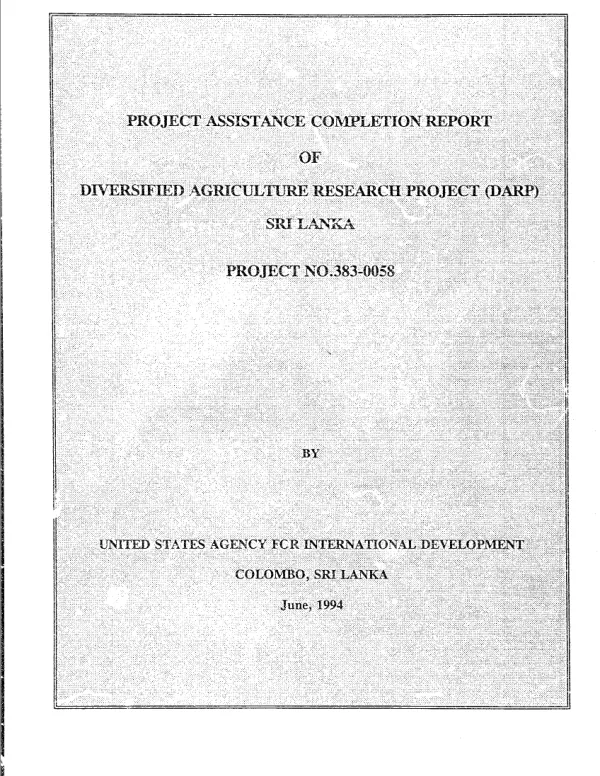
Project assistance completion report of diversified agriculture research project (DARP), Sri Lanka -- project no. 383-0058
Sign inUSAID. MISSION TO SRI LANKA
Project assistance completion report of diversified agriculture research project (DARP), Sri Lanka -- project no. 383-0058
PACR of a project (8/84-8/93) to strengthen the capability of Sri Lanka's Department of Agriculture (DOA) to generate and transfer technologies and seed for small farm production of subsidiary food crop.
1994
Sign in to readA free account is required to download.
Abstract
The project has been effective and beneficial. It has: increased the DOA's research capability through improved research planning, overseas training of 448 staff (65 long-term, 383 short-term), technical input to programs, and improved facilities and equipment; appreciably increased research trials on diversified crops; and assisted the DOA in adapting to a mass media strategy from the ineffective and costly field extension method. In addition, project support for institutional and policy development facilitated a move from a fully public sector seed trade to private sector seed import and a growing local seed production industry and led to a complete restructuring of the DOA and the formation of a Horticultural Research Institute. Most importantly, though difficult to quantify, the project effected a widespread change in attitude and orientation of the agricultural establishment, leading to the acceptance of (1) a policy of food self-reliance rather than self-sufficiency, (2) the importance of the private sector, (3) the need for agricultural commercialization and diversification to increase incomes for the rural poor, and (4) the need for government research and technical services to be responsible to clients. The impact of agricultural research could potentially be substantial, although considerable time is required to disseminate and yield benefits. Thus far, annual production of chilies and onions increased by 1,160 MT and 5,739 MT, respectively, between 1981 and 1992, for an annual net gain of US $4.5 million. The success of the project can be largely attributed to a shift in emphasis, beginning in 1990, from subsidiary food crops to high-value horticultural crops, from public sector control and import substitution goals to market and demand-driven priorities, and from food to farm incomes and employment -- all within a client-centered context. These changes accompanied and reinforced a shift in government policies toward a market economy, private sector development, and export promotion. Thus, the project and the government made changes supported by the USAID Strategic Framework, which calls for expanding opportunities through a new private-public partnership and agriculturally led industrialization. Several of the project's design assumptions appear not to have held true: (1) that emphasis on rice was preventing attention to other crops -- the DOA was able to continue an extensive rice program, while expanding work on other food crops and horticulture; (2) that lack of technology was the major factor inhibiting subsidiary food crops -- in fact, low profitability due to poor market organization was an equal constraint; (3) that the Training and visit (T&V) extension system would be adequate -- T&V was initially effective, but proved costly and unsustainable. The following lessons were taught. (1) Flexibility is crucial -- the project evolved appropriately to align itself with changing host government policy and USAID ideology. (2) Externally funded projects tend to help organizations set their own agenda without having to compete for scarce government funds. Unless adequate emphasis is placed on the needs of ultimate clients, small farmer and commercial farmer projects may not address real needs. (3) Very ambitious baseline surveys are overly complicated and time consuming, analysis comes late, and follow-up is not done; simpler periodic appraisals seem more useful.
Related documents