MIDWEST UNIVERSITIES CONSORTIUM FOR INTERNATIONAL ACTIVITIES, INC. (MUCIA)
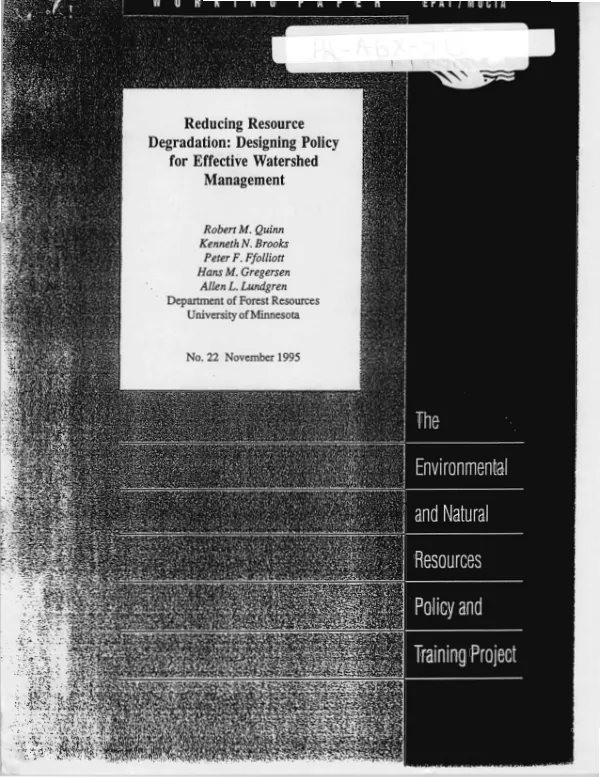
Reducing resource degradation : designing policy for effective watershed management
Throughout the world, massive spontaneous migration and planned resettlement to upland areas have resulted in overexploitation and degradation of land and water resources, threatening the present and future sustainability of the livelihood, health, and well-being of millions of residents of both upland and downstream areas.
Quinn, Robert M.; Brooks, Kenneth N. · 1995
Sign in to readA free account is required to download.
Abstract
Policy makers face a number of challenges in dealing with these issues. Social and political institutions rarely coincide with watershed boundaries. Usually there is a diverse set of stakeholders concerned with the resolution of upland land use issues. And commonly a number of other sectors and issues that affect upland resource use carry more political clout than considerations of upland conservation. Using a watershed management perspective, this working paper provides a framework for the assessment and design of policies and programs to help achieve productive and sustainable upland resource use. There are a number of factors that policy makers should consider. They need to identify all stakeholders and understand their perceptions and attitudes. Jurisdiction over lands and activities among different government agencies must be clarified, and coordination among them improved. Watershed residents often have the greatest potential for managing local resources. Policy should be designed to encourage this. A major barrier to effective watershed management is the inequitable distribution of benefits to those who employ sound land use practices and the failure of those responsible for resource degradation to bear the costs. Policy can be used to help correct this. Lastly, policy makers need better assessment of the impacts of current policy on order to design more effective policy for the future. Includes references. (Author abstract)
Related documents
![Participatory watershed planning in San Francisco Menendez[, El Salvador]](https://covers.devme.ai/gen/59254.webp)