USAID DEC
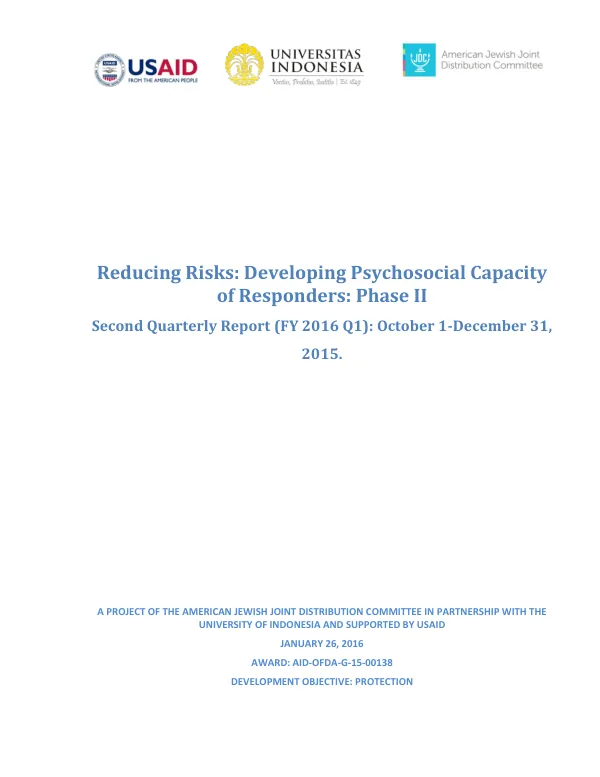
Reducing Risks: Developing Psychosocial Capacity of Responders: Phase II Second Quarterly Report (FY 2016 Q1): October 1-December 31, 2015
Sign inUNIVERSITY OF MARYLAND
Reducing Risks: Developing Psychosocial Capacity of Responders: Phase II Second Quarterly Report (FY 2016 Q1): October 1-December 31, 2015
Reducing Risks: Developing Psychosocial Capacity of Responders is a project aimed at enhancing the ability of responders to provide psychosocial support in disaster situations.
2016 · 3 pages
Sign in to readA free account is required to download.
Abstract
The project is a collaboration between the American Jewish Joint Distribution Committee (JDC) and the University of Indonesia, with support from the United States Agency for International Development (USAID). The project's development objective is to enhance protection in disaster-affected communities. Key achievements in the first quarter of Fiscal Year 2016 include the signing of an agreement between JDC and the University of Indonesia, marking the beginning of a new partnership framework. This partnership is expected to ensure the sustainability of the intervention and improve the infrastructure for psychosocial support in Disaster Risk Reduction throughout Indonesia. The agreement was finalized after several weeks of review by the University of Indonesia, following a change in its oversight policies. JDC's Technical Advisor and Area Director traveled to Jakarta in November 2015 to meet with the University's Dean and Crisis Center staff, solidifying the partnership. The University of Indonesia signed the agreement with JDC on December 17, 2015, for Phase II of the Reducing Risks initiative. Planning activities for 2016 focus on refining training and improving network coordination. JDC has commenced working with local staff to provide compliance training and develop a robust timeline of activities for Year 1. The first milestone event will be the Curriculum Revision Workshop, scheduled for late February 2016, which will refine the psychosocial training curriculum developed during Phase I of the project. The workshop will engage stakeholders from various project partners, including the University of Indonesia, Atma Jaya University, the Ministry of Social Affairs, and the Indonesia Psychology Union. The project aims to ensure full coordination with other agencies and avoid program duplication. Key to this process has been developing a relationship with the Ministry of Social Affairs, which has been mandated to oversee psychosocial support programs in the country. A formal meeting with MOSA representatives was held in December 2015, where plans were put in place for a gathering of all agencies involved in psychosocial programming to review activities in 2015. The meeting closed with the decision that all stakeholders would gather to conduct a collaborative planning session in 2016 to achieve maximum breadth and impact of programming. The project also aims to expand the dissemination of the refined psychosocial training curriculum to new locations. Options for new locations include the Karo District-North Sumatera, Central Moluccas District-Moluccas Province, Alor District-East Nusa, Tenggara, Bandung-West Java, and Jakarta province. JDC is currently conducting a feasibility check to determine which high-risk region will be selected for the expansion, utilizing selection criteria that include the degree of need for the program, logistical feasibility, assessment of priority areas, capacity to test and implement the revised curriculum, and strategic significance as a platform for national advocacy and dissemination.
Related documents