USAID DEC
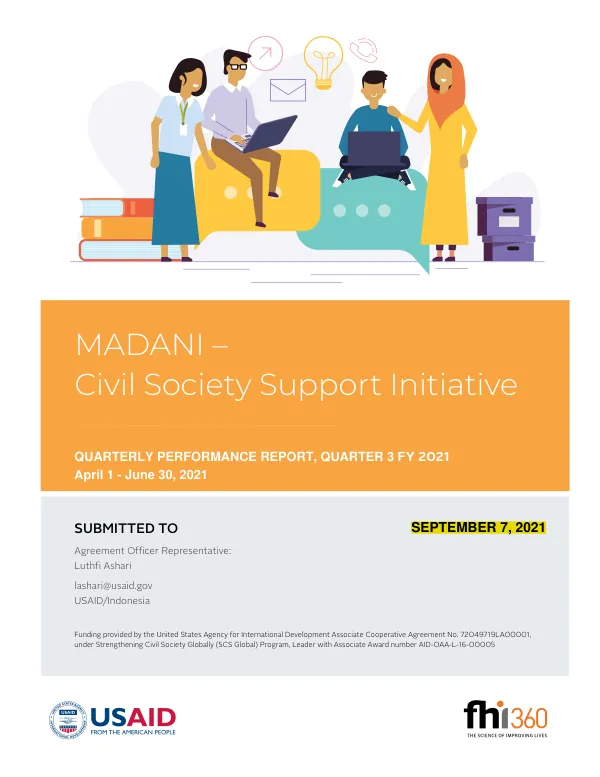
Quarterly Performance Report, Q3 FY 2021: MADANI – Indonesia Civil Society Support Initiative
Sign inFHI 360
Quarterly Performance Report, Q3 FY 2021: MADANI – Indonesia Civil Society Support Initiative
The MADANI Civil Society Support Initiative is a five-year program funded by the U.S.
2021 · 54 pages
Sign in to readA free account is required to download.
Abstract
Agency for International Development (USAID) and implemented by FHI 360. The program aims to improve the advocacy capacity of civil society organizations (CSOs) and strengthen government accountability and communal tolerance by promoting mechanisms, processes, and incentives that result in more transparent, accountable, and participatory governance practices at the subnational level in Indonesia. MADANI supports local CSO partners' journeys to self-reliance by focusing on capacity needs identified by the CSOs themselves and supporting implementation of the development solutions they have identified through the Learning Forum. During Quarter 3 (Q3) of fiscal year (FY) 2021, MADANI has developed and deepened its desired development outcomes and made progress toward program targets. The program continued to build the effectiveness and efficiency of its partner CSOs through its technical assistance (TA) and support system to improve local CSOs' capacity and legitimacy by leveraging stakeholders in the Learning Forum. MADANI also improved CSO self-reliance by exploring opportunities for partnerships and funding opportunities with local government and the private sector. Additionally, the program provided policy recommendations and advocacy on the priority service delivery theme selected in each district. Twenty-one out of 24 MADANI Lead CSO Partners (LPs) have improved performance as measured through their annual Organizational Performance Index (OPI) assessments. Nine LPs used MADANI training materials to provide training to fellow Learning Forum members, bringing the FY21 cumulative total to 32. Five LPs' policy recommendations in priority sectors are being reviewed by their respective local governments (LGs) on issues such as establishing LG task forces, revising the public procurement audit requirements for CSOs, and increasing the budget for CSO capacity building. Twenty-eight MADANI LPs have been invited to government or local parliament (DPRD) hearings, many for the first time. MADANI's progress on these workstreams demonstrates the program's commitment to improving the advocacy capacity of CSOs and strengthening government accountability and communal tolerance in Indonesia. The program's focus on capacity needs identified by CSOs themselves and its support for implementation of development solutions through the Learning Forum have been key to its success. By building the effectiveness and efficiency of its partner CSOs and improving CSO self-reliance, MADANI is helping to create a more transparent, accountable, and participatory governance environment in Indonesia. The program's progress also highlights the importance of partnerships and collaboration in achieving its goals. MADANI's partnerships with local government, media, and the private sector have been instrumental in providing policy recommendations and advocacy on priority service delivery themes. The program's ability to leverage stakeholders in the Learning Forum has also been critical in improving the capacity and legitimacy of its partner CSOs. Overall, MADANI's progress during Q3 of FY 2021 demonstrates the program's commitment to improving the advocacy capacity of CSOs and strengthening government accountability and communal tolerance in Indonesia. The program's focus on capacity needs identified by CSOs themselves and its support for implementation of development solutions through the Learning Forum have been key to its success.