USAID DEC
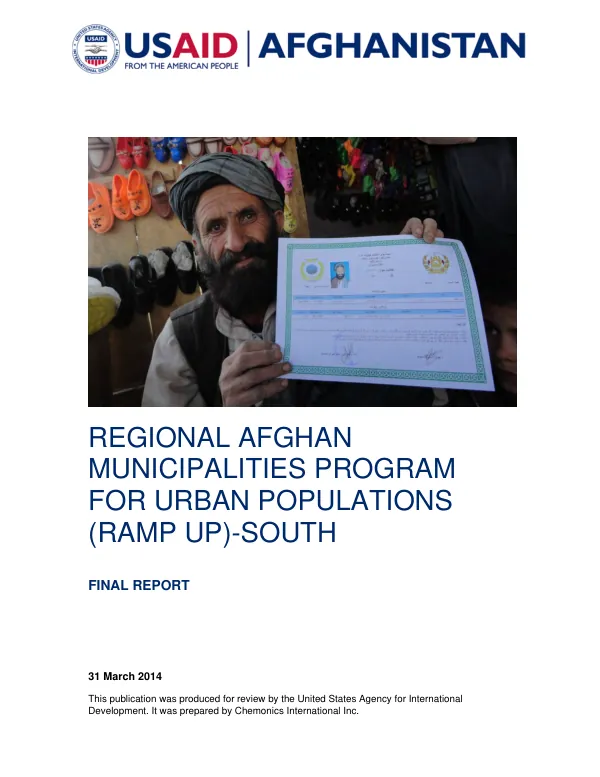
Regional Afghan Municipalities Program for Urban Populations (RAMP UP)-South Final Report
Sign inCHEMONICS
Regional Afghan Municipalities Program for Urban Populations (RAMP UP)-South Final Report
Regional Afghan Municipalities Program for Urban Populations (RAMP UP)-South was launched in June 2010 by the United States Agency for International Development (USAID) to promote effective, responsive, democratic, transparent, accountable, and gender-sensitive public administration in six targeted municipalities in southern Afghanistan.
2014 · 80 pages
Sign in to readA free account is required to download.
Abstract
The program's designated operational area was the municipal capitals of the six provinces comprising the International Security Assistance Force's Regional Command-South: Kandahar City in Kandahar province, Lashkar Gah in Hilmand, Tirin Kot in Uruzgan, Zaranj in Nimroz, Qalat in Zabul, and Nili in Daykundi. Decades of conflict have had a highly destructive impact on Afghanistan's physical, political, economic, and institutional infrastructure, eroding public confidence in the government's ability to execute its core functions. Building a strong public administration that delivers high-quality public services, solicits and incorporates citizen feedback into policy decisions, and protects marginalized and vulnerable groups is crucial to the sustainability of Afghanistan's development. The Afghan government has been working closely with the international community to rebuild the public sector and improve infrastructure throughout the country. RAMP UP-South aimed to strengthen municipal governance and Afghan-led development by providing strategic support to the target municipalities to build their institutional and administrative capacity. The program worked closely with its key national government partners, the Independent Directorate of Local Governance (IDLG) and General Directorate of Municipal Affairs (GDMA), along with provincial reconstruction teams and other USAID- and donor-funded programs. As a result of RAMP UP-South's activities, Afghan citizens now have greater access to clean water and sanitation, solid waste management, education, and other essential services. The program focused on several key areas, including service delivery, financial management, sustainable economic growth, citizen engagement, transparency and accountability, and municipal capacity and sustainability. RAMP UP-South implemented the Integrated Financial Management System (IFMS) to improve financial management and budget preparation and execution. The program also supported private sector engagement and designed local economic development plans to promote economic growth and job creation. RAMP UP-South also worked to engage citizens through public outreach and encouraged citizen participation in municipal decision-making processes. The program established municipal advisory boards to improve transparency and access to information and assessed citizen satisfaction with municipal services. Additionally, RAMP UP-South built municipal capacity by developing standard operating procedures and an effective competency matrix. The program's achievements and results are significant, with notable improvements in service delivery, financial management, and citizen engagement. The program's extension of technical assistance to smaller district municipalities through pilot programs has also been successful. RAMP UP-South's activities have contributed to the sustainability of Afghanistan's development and have helped to build a strong public administration that delivers high-quality public services to its citizens.