USAID DEC
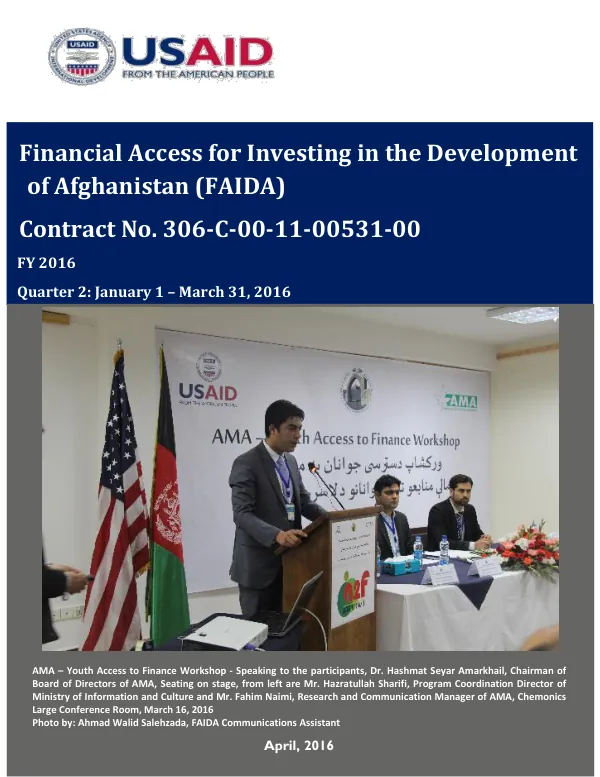
Financial Access for Investing in the Development of Afghanistan (FAIDA) Quarter 2: January 1 – March 31, 2016
Sign inCHEMONICS
Financial Access for Investing in the Development of Afghanistan (FAIDA) Quarter 2: January 1 – March 31, 2016
The FAIDA project, under Contract Number 306-C-00-11-00531-00, assists the Government of the Islamic Republic of Afghanistan and the private sector in developing the financial sector.
2016 · 95 pages
Sign in to readA free account is required to download.
Abstract
The project's primary objective is to build capacity to deliver finance where it can be used most effectively, and to develop a legal framework and market infrastructure in which financial sector institutions and their business partners create value that provides growth and employment opportunities for all Afghans. The project focuses on five key components: Enterprises, Banking Capacity, Regulatory, Better Than Cash, and Gender Mainstreaming. The Enterprises Component works with partner institutions to provide tailored financial solutions where access to capital will complete value chains and increase competitiveness. The Banking Capacity Component enhances the capacity of financial professionals and organizations to strengthen Afghanistan's financial sector. The Regulatory Component creates an enabling lending environment that reduces risk and develops new or updated regulations across all financial sectors and key institutions. The Better Than Cash Component provides technical assistance to Afghanistan's mobile network operators to introduce innovative new products and services and expand the use of mobile money. The Gender Mainstreaming Unit ensures that women are integrated into financial sector activities and are provided access to finance and other opportunities for economic and professional growth. The project's geographic coverage includes the entire country, with a focus on remote areas. The project has established partnerships with various organizations, including Chemonics International Inc., Conexus Corporation, Crimson Capital Corporation, Micro Banking International Foundation, Services International Limited, LLC, and Afghan Police Protection Force (APPF). The project's activities are guided by a range of acronyms, including A2F (Access to Finance), AACC (Afghan American Chamber of Commerce), AAEP (Afghanistan Agriculture Extension Project), and AIB (Afghanistan International Bank). The project's implementation is overseen by a range of stakeholders, including the Government of the Islamic Republic of Afghanistan, the private sector, and international organizations. The project's progress is monitored through a range of indicators, including the number of financial institutions established, the amount of capital mobilized, and the number of women accessing financial services. The project's impact is expected to be significant, with the potential to increase access to finance for millions of Afghans, stimulate economic growth, and reduce poverty. The project's long-term goal is to achieve long-term stability, security, and enduring peace in Afghanistan.