USAID. BUR. FOR LATIN AMERICA AND THE CARIBBEAN. REGIONAL OFC. FOR CENTRAL AMERICAN PROGRAMS (ROCAP)
Regional integrated pest management
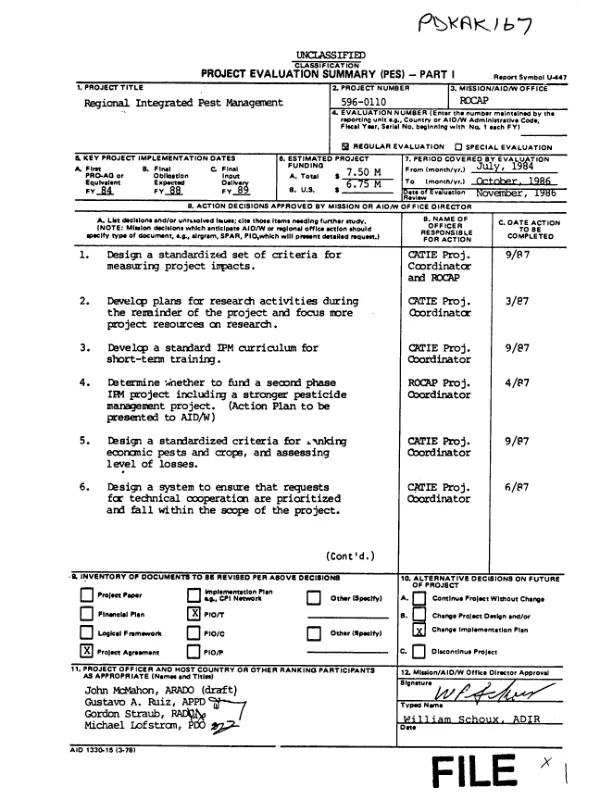
Summarizes and comments upon attached midterm evaluation (PD-AAV-510) of a project to strengthen regional and national capabilities to implement effective integrated pest management (IPM) in Central America and Panama.
McMahon, John; Ruiz, Gustavo A. · 1986
Sign in to readA free account is required to download.
Abstract
Evaluation covered the period 7/84-10/86 and was based upon document review, site visits, and interviews with participating officials. Lessons learned implied by the attached evaluation include the importance of: (1) long-term funding commitments for research and development programs; (2) a highly qualified, deeply committed team of specialists working full time and over the long term; (3) effective technical and administrative backstopping on the part of both funding and implementing institutions; (4) carefully developed and implemented monitoring and evaluation systems to measure project impacts; (5) staff performance incentives; and, (6) including professional staff at various levels in planning and implementation decisions. The evaluation notes that the sustainability of the program is heavily dependent on the Tropical Agriculture Research and Training Center"s (CATIE) commitment to the program and on CATIE"s ability to secure long-term funding from budget sources or from donors. Twenty-one recommendations were made, covering research, training, technical cooperation, and environmental and other issues; included is a recommendation that steps be taken to initiate a renewal of the project for 5 more years. Action decisions for CATIE and/or ROCAP are to: (1) develop a standardized set of criteria for measuring project impacts; (2) develop plans for research activities during the remainder of the project and to focus more project resources on research; (3) develop a standard IPM curriculum for short-term training; (4) determine whether to fund a second phase project including a stronger pesticide management component; (5) design a standard set of criteria for ranking economic pests and crops and for assessing levels of losses; (6) design a system to ensure that requests for technical cooperation are prioritized and fall within the scope of the project; (7) solicit funding support for national institutions included in pest diagnostic laboratory network; (8) provide country coordinators with computer equipment to meet data analysis needs.