TROPICAL RESEARCH AND DEVELOPMENT, INC.
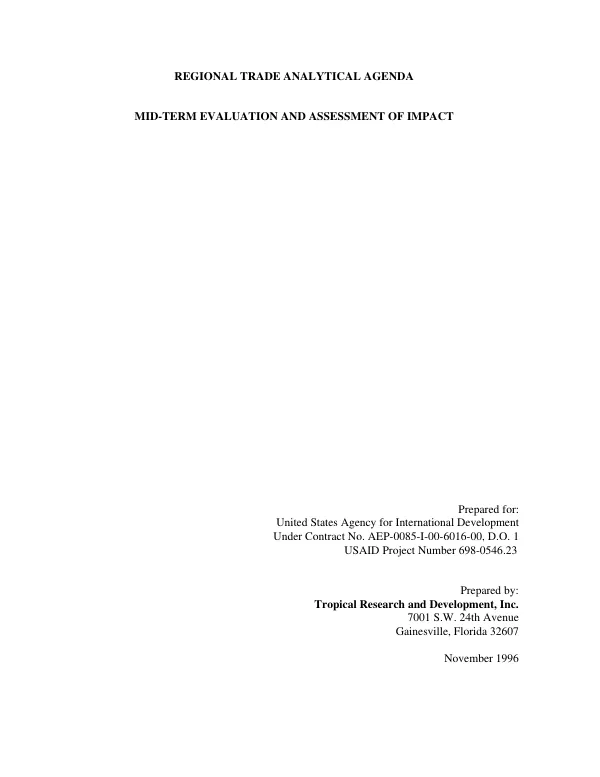
Regional trade analytical agenda : mid-term evaluation and assessment of impact
Evaluates the Regional Trade Analytical Agenda (RTAA), a component of the Equity and Growth through Economic Research (EAGER) project in sub-Saharan Africa.
Mwale, Sam Mwamburi|Ross, Jack|Zalla, Tom · 1996
Sign in to readA free account is required to download.
Abstract
The project is being implemented through cooperative agreements with Technoserve and University of Swaziland's Center for Applied Research and Policy Analysis (CARPA), which was established especially for this project. Mid-term evaluation covers the period 1993-11/96. The RTAA is an extremely promising activity, mainly because of flexible design, its reliance on African input, and the excellent performance of its two implementing agencies. It represents an innovative approach to USAID's entire applied research and policy analysis process. Its research agenda was established via a lengthy process of soliciting information priorities regarding intra-African trade in eastern and southern Africa, and it relies heavily on involving African researchers, technical support personnel, and policy makers in research design, execution, and dissemination, making good use of study definition/planning workshops which create local ownership of the results and reflect Africa's oral culture. Though risky (since it may lead to conclusions unacceptable to USAID), the emphasis on local participation probably reduces local resistance to unpopular findings on controversial issues (as compared to conventional studies done by expatriates). It also provides African researchers with opportunities for contract work in the region and thus counteracts brain drain. USAID's choice of a cooperative agreement rather than a contract as the implementation mechanism was a wise one. Cooperative agreements promote flexibility and are ideally suited for developing local capacity. Both Technoserve and CARPA have performed well in virtually all regards, while USAID's management assistance has also been skillful. Through their RTAA work, African firms and institutions (e.g., The Management Center and the University of Malawi's Agricultural Policy Research Unit) are developing a commercially viable analytical and policy lobbying capacity. Participation in the studies by African policy makers and technical advisors is also significant, with the more recent studies typically being guided by country technical/coordinating teams comprised almost entirely of Africans. RTAA supports REDSO's strategic objectives (SOs) 2 and 3 by providing regional trade studies and analyses; it also addresses SOs 1 and 3 of the Greater Horn Of Africa Initiative (GHAI) and SOs 2-4 of the Initiative for Southern Africa (ISA). Results indicators may be hard to come by right now, however, for RTAA puts more emphasis on process than outcome. There are two dimensions in which it clearly excels: who does the study, and how is he/she/it connected to the policy environment RTAA is trying to change. As the studies' findings get discussed and digested, however, policy changes will become visible and it will become feasible for RTAA to establish quantitative targets such as savings in transport costs or savings from more efficient trade. The study entitled Comparative Costs of Transportation in East Africa has been well-received by governments and regional bodies such as the East African Co-operation. The comparative cost studies, and the structural adjustment analysis for Southern Africa also appear to have been well-received by the regional governments. Some of the findings have been incorporated into the 8/96 Free Trade Protocol signed by all Southern Africa Development Community (SADC) countries, except Angola. To make RTAA's flexibility more rigid, and perhaps more controllable by USAID, would probably harm the project, which should continue essentially unchanged until the PACD. It should be noted, however, that the tremendous leadership the project has enjoyed will limit its replicability: it is not easy to find Americans who can do this kind of work successfully.