USAID. MISSION TO ZAMBIA
Regional transport and storage-phase II Kafue-Lusaka road
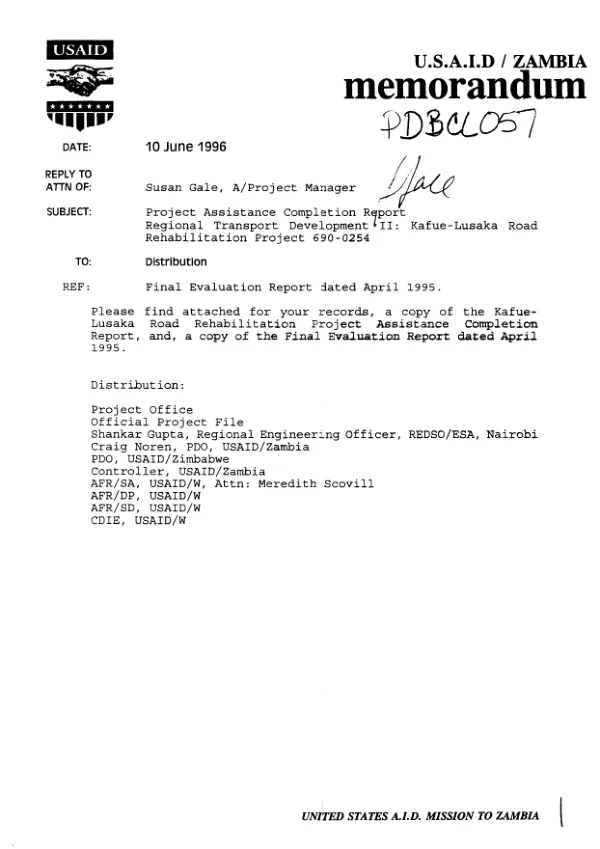
Summarizes attached final evaluation (XD-ABM-707-A) of a project (1990-6/95) to provide 53.4 km of high-quality road from Lusaka to Kafue in Zambia.
1996
Sign in to readA free account is required to download.
Abstract
A previous USAID project had constructed an 81 km connection between Kafue and Chirundu at the Zimbabwe border. The road has been completed according to specifications and within the planned time frame and budget. The quality of construction is excellent and the road includes several added features, such as road marking, traffic lights, and improved drainage. The completed road consists of about 4 km of six-lane highway, 11 km of four-lane highway, and 38 km of two-lane undivided highway. The improved infrastructure will accommodate a projected annual traffic increase of 5-7%. Major disputes developed between the original contractor and the Government of Zambia (GRZ) over payments, in view of deteriorating foreign exchange rate fluctuations. The issue was so severe that the GRZ was unable to successfully negotiate a major change order with the contractor for additional improvements. Subsequently, the contract had to be split, and tenders for a new contractor to complete the additional work were solicited. With the help of an outside consultant, the dispute was resolved and the original contractor was compensated for the unanticipated foreign exchange rate fluctuations. This use of a professional services firm to undertake the complex research and analysis task and mediate contractual issues was a major factor in the success of the project. The GRZ Road Department, which is responsible for maintenance of the road, could not identify current or planned resources or a work plan for this task. The GRZ does have trained personnel who may be qualified for the task, but its budgetary allocation remains uncertain. Also, the Pro-Ag specifies that the Road Department will reseal the 81 km of road between Kafue and Chirundu. As of 4/95, the Department had completed 52 km with USAID-provided local currency. Additional local currency funding has been sought for the remaining work. However, due to the Department"s inability to account satisfactorily for the local currency provided them under several previous agreements and to assure USAID that past accounting deficiencies will not be repeated, USAID refused the request and asked that the work be completed within the ordinary GRZ budget. In addition, the GRZ has yet to develop a mechanism to correct the considerable vandalism, theft, and destruction that have occurred to traffic controls, lighting standards, and other road-related property. Lessons learned are as follows. (1) If the local currency is weak and unstable and the foreign exchange rate against the dollar may drop significantly, a 100% U.S. dollar value contract should be considered for USAID-funded construction contracts in order to avoid disputes and delays. (2) Where a construction contract is based partly in U.S. dollars and partly in local currency, a reasonable rationale should be developed and incorporated into the contract document for adjustments due to the fluctuations of local currency exchange rates.