ADVANCED ENGINEERING ASSOCIATES INTERNATIONAL, INC. /SGGA
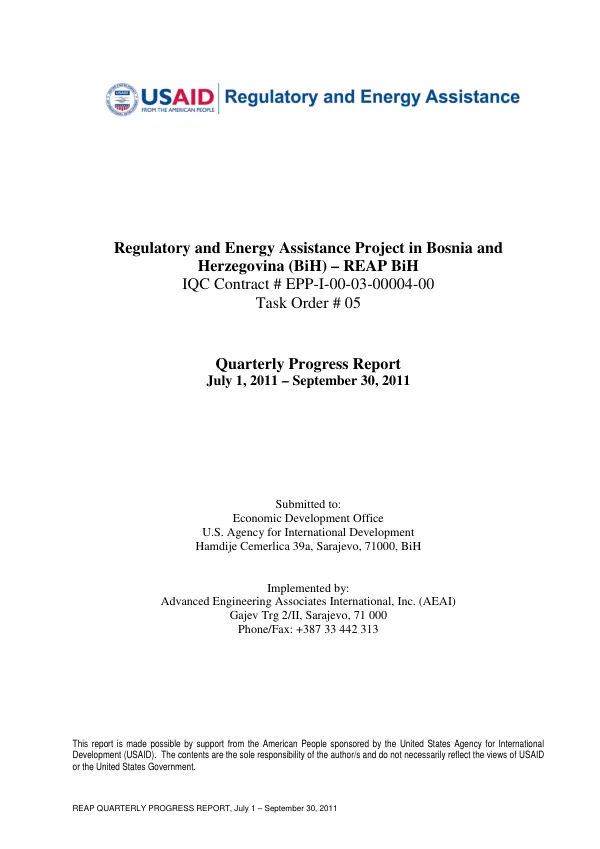
Regulatory and Energy Assistance Project in Bosnia and Herzegovina (BiH) – REAP BiH
The Regulatory and Energy Assistance Project in Bosnia and Herzegovina (BiH) – REAP BiH, implemented by Advanced Engineering Associates International, Inc.
2011 · 18 pages
Sign in to readA free account is required to download.
Abstract
(AEAI), aims to achieve a fully integrated energy sector into the regional market and the EU, and to restructure and commercialize energy companies. The project's two main objectives remain the same, with tasks under each objective having changed. Market opening involves removing market impediments, and REAP works to harmonize the regulatory work of the three commissions to facilitate integration of the market into the regional and EU markets. The project assists the State institutions to facilitate BiH speaking with one voice in internal and international liberalization, including gaining familiarity with the EU Third Liberalisation Package. Additionally, REAP assists the State Ministry for Foreign Trade and Economic Relations (MOFTER) to continue efforts on the state gas law. Regarding the second Task Objective, restructuring and commercialization of energy companies, REAP works in three areas: assisting the Federation to develop the Electricity Law, commenting on the EPs' restructuring documents, and assisting the EPs to develop and implement solutions to receive revenues that reflect their justified costs. Significant activities during the quarter included the creation and activation of a Default Supplier Mechanism. The three regulatory commissions discussed the Default Supplier Market Opening Concept, and REAP formulated a new document to consolidate input from the commissions and suggest a final position. The document was sent to the two Entity regulatory commissions and later discussed in a meeting. The key issues discussed by the attendees were the discrepancy between the three regulatory commissions on two important issues. While RSERC and SERC chose the options where regulated tariffs are eliminated for all customers but households and small customers all at once, FERC chose the option to eliminate regulated tariff gradually, first for those customers connected to the 110 kV network. REAP commented on this inconsistency and suggested further harmonization of Default Supplier solutions. Technical assistance was provided to revise the New FERC Tariff Model, and REAP analyzed the submitted model to ensure its accuracy. The project also began research on the best EU and Regional practices on Ancillary Services and Balancing, identifying the status of implementation of the SERC Decision on Ancillary Services Tariff and Rules on the Methodology to determine ISO and Ancillary Services Tariffs. The current functioning of the Ancillary Services System in BiH is unsatisfactory, with Ancillary Service Providers not providing secondary and tertiary reserves as obliged by a SERC decision. This has resulted in periodic unplanned imbalances within the regulatory block with neighboring countries. The EPs identified metering system as a crucial obstacle to the proper functioning of ancillary services. The project's overall task progress chart shows that the majority of tasks are on track, with some delays in the implementation of the Default Supplier Mechanism. The project's status of activities as defined in the work plan indicates that some tasks are behind schedule, while others are ahead of schedule. The project's progress per impact indicators shows a 27% increase in household income among program participants compared to the control group. The project's implementation details include the creation and activation of a Default Supplier Mechanism, technical assistance to revise the New FERC Tariff Model, and research on the best EU and Regional practices on Ancillary Services and Balancing. The project's geographic focus is on Bosnia and Herzegovina, with a specific emphasis on the energy sector. The project's timeframes are from July 1, 2011, to September 30, 2013, with a focus on achieving a fully integrated energy sector into the regional market and the EU, and restructuring and commercializing energy companies.