USAID DEC
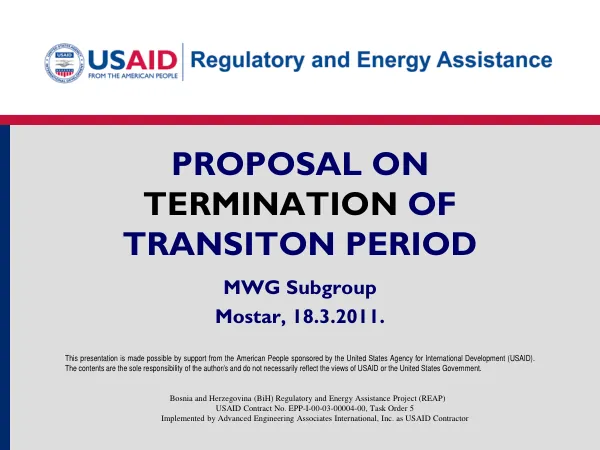
Proposal on Termination of Transition Period for Bosnia and Herzegovina Regulatory and Energy Assistance Project
Sign inADVANCED ENGINEERING ASSOCIATES INTERNATIONAL, INC. /SGGA
Proposal on Termination of Transition Period for Bosnia and Herzegovina Regulatory and Energy Assistance Project
The Regulatory and Energy Assistance Project (REAP) in Bosnia and Herzegovina (BiH) aims to facilitate the transition to a competitive energy market.
2011 · 16 pages
Sign in to readA free account is required to download.
Abstract
The project focuses on the 110 kV network, where customers are currently supplied with regulated tariffs. The transition period is expected to end in 2012, and four options are presented for consideration. Option 1 involves forcing customers to buy electricity at market prices as of January 1, 2012. To implement this option, several actions are required, including unbundling the electricity distribution company (DSO) and the supplier in the Republika Srpska (RS), and establishing a proposed agreement on ancillary services. The details of the short-term operating reserve (SOLR) process must also be defined and contracts developed and approved. Option 2 proposes a gradual removal of regulated tariffs and the introduction of a distribution service (DS) service. Eligible customers would have the right to use the DS service, with a regulated price that moves closer to the market price over the transition period. After the transition period, the DS service could be purchased by the supplier through a tendering procedure. Option 3 involves a gradual removal of regulated tariffs, with customers purchasing part of their load on the market and part at regulated prices. This option is similar to the Regional Wholesale Market, where the establishment of a day-ahead market (DAM) is prescribed. To implement this option, the supply and DSO should be unbundled in the RS, and the electricity production company (EP) should be unbundled in the Federation of Bosnia and Herzegovina (FBiH). Option 4 proposes extending the transition period and maintaining regulated tariffs. Eligible customers would continue to buy electricity at tariff prices, with the current situation maintained. To implement this option, an action plan should be developed and implemented to remove impediments to the successful functioning of the market after the transition period. The same options are presented for customers connected to the 35 and 10 kV networks. The actions required for each option are similar to those for the 110 kV network, with some modifications. For example, adequate metering systems should be installed for customers connected to the 35 and 10 kV networks. In all options, several issues should be considered, including the processes regarding ancillary services, balancing, transmission service provider (TPA), and SOLR, which should be described and covered by appropriate contracts. The time required to implement these actions should also be taken into account. The Regulatory and Energy Assistance Project aims to facilitate the transition to a competitive energy market in Bosnia and Herzegovina. The four options presented provide a framework for the transition period, with actions required to implement each option. The success of the transition period depends on the timely implementation of these actions and the consideration of the issues mentioned above. The transition period is expected to end in 2012, and the implementation of the chosen option will determine the future of the energy market in Bosnia and Herzegovina. The Regulatory and Energy Assistance Project will continue to provide support and guidance to ensure a smooth transition to a competitive energy market.