BOOZ, ALLEN AND HAMILTON, INC.
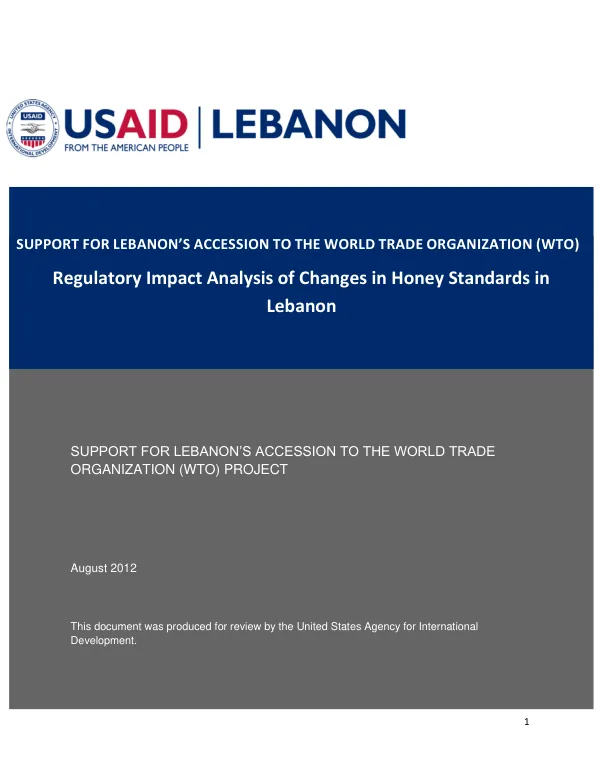
Regulatory Impact Analysis of Changes in Honey Standards in Lebanon
Regulatory Impact Analysis of Changes in Honey Standards in Lebanon was conducted by Booz Allen Hamilton as part of the USAID Support for Lebanon's Accession to the World Trade Organization Project.
2012 · 27 pages
Sign in to readA free account is required to download.
Abstract
The analysis aimed to evaluate the benefits and costs of altering the standards on the composition and quality factors of honey imported into Lebanon. The Lebanese standard Institution, LIBNOR, is implementing a set of standards on the essential composition and quality factors of honey sold in the domestic Lebanese market. Currently, importation of honey into Lebanon is subject to a maximum of 20mg/kg in HMF content, in contrast to the Codex standard and to the limits imposed on domestic producers which are set at 40mg/kg in HMF content. LIBNOR is proposing to amend the current honey regulation in order to comply with the Codex standard and therefore lifting the maximum HMF level condition for imported products. A classical RIA analysis was based upon a rigorous cost-benefit analysis framework, which estimates the benefits and costs incremental to a set baseline. However, due to the lack of consistent and comprehensive data on the honey market and related economic variables, it was decided to restrict the RIA to a simple qualitative Cost and Benefit Analysis using a Process Model Worksheet methodology developed by Booz Allen Hamilton. The analysis identified that most stakeholders will be beneficiaries from the introduction of the new standard, including consumers, government, import companies, and retailers. However, beekeepers will be the only cost bearers. In the short-term, Lebanese producers are expected to operate at a competitive disadvantage because their honey production facilities are much smaller relative to their international competitors. The analysis also showed that the introduction of the new standard will have a positive impact on the honey market in Lebanon. The benefits of the new standard include increased market access for imported honey, improved quality of honey sold in the domestic market, and increased competitiveness of Lebanese honey producers. The costs of the new standard include the costs associated with implementing the new standard, including training and equipment costs for beekeepers. The benefit-cost ratio of the new standard is expected to be greater than 1, indicating that the expected benefits exceed the expected costs. The analysis concluded that the introduction of the new standard is expected to result in net benefits for the honey market in Lebanon. The Regulatory Impact Analysis of Changes in Honey Standards in Lebanon provides a detailed analysis of the potential costs and benefits of altering the standards on the composition and quality factors of honey imported into Lebanon. The analysis identified that the introduction of the new standard will have a positive impact on the honey market in Lebanon, including increased market access for imported honey, improved quality of honey sold in the domestic market, and increased competitiveness of Lebanese honey producers. The analysis also identified that the costs of the new standard include the costs associated with implementing the new standard, including training and equipment costs for beekeepers. However, the benefit-cost ratio of the new standard is expected to be greater than 1, indicating that the expected benefits exceed the expected costs. The Regulatory Impact Analysis of Changes in Honey Standards in Lebanon provides a comprehensive analysis of the potential costs and benefits of altering the standards on the composition and quality factors of honey imported into Lebanon. The analysis provides a detailed analysis of the potential benefits and costs of the new standard, including the impact on the honey market in Lebanon, the costs associated with implementing the new standard, and the benefit-cost ratio of the new standard. The analysis concluded that the introduction of the new standard is expected to result in net benefits for the honey market in Lebanon. The analysis provides a comprehensive analysis of the potential costs and benefits of altering the standards on the composition and quality factors of honey imported into Lebanon, and provides a detailed analysis of the potential benefits and costs of the new standard.