JHPIEGO
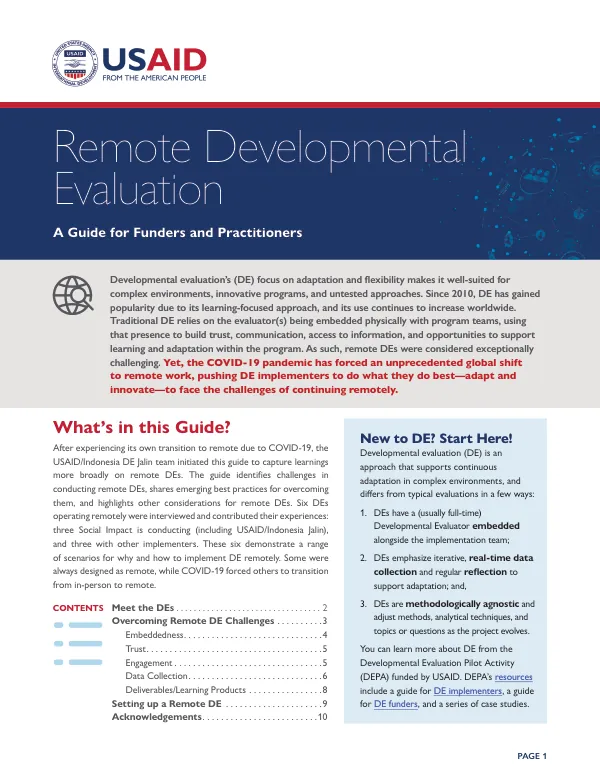
Remote Developmental Evaluation: A Guide for Funders and Practitioners
Developmental evaluation (DE) is an approach that supports continuous adaptation in complex environments.
2021 · 10 pages
Sign in to readA free account is required to download.
Abstract
It differs from typical evaluations in several ways, including the presence of a full-time developmental evaluator embedded alongside the implementation team, iterative and real-time data collection, and methodological agnosticism. DEs are well-suited for complex environments, innovative programs, and untested approaches. Since 2010, DE has gained popularity due to its learning-focused approach, and its use continues to increase worldwide. Traditional DE relies on the evaluator being embedded physically with the program team, using this presence to build trust, communication, access to information, and opportunities to support learning and adaptation within the program. However, the COVID-19 pandemic has forced a global shift to remote work, pushing DE implementers to adapt and innovate. The USAID/Indonesia DE Jalin team initiated a guide to capture learnings on remote DEs. The guide identifies challenges in conducting remote DEs, shares emerging best practices for overcoming them, and highlights other considerations for remote DEs. Six DEs operating remotely were interviewed and contributed their experiences, demonstrating a range of scenarios for why and how to implement DE remotely. One of the key challenges of remote DE is building trust and relationships with the implementation team. Evaluators must integrate enough to easily access the team's processes, formal and informal data, and decision makers, while remaining independent. In the initial embedding phase, evaluators seek to access documents, join team meetings and communications, and begin observations/data collection. Face-to-face interaction accelerates this embedding and trust-building. Remote settings challenge many DE components, including building trust, relationships, and access without the advantage of a physically accessible team. Evaluators who are forced to transition to remote must adjust their approach to compensate for the lack of in-person communication. These limitations can ripple throughout the DE, making it difficult to facilitate a high level of reflection, adaptation, and innovation. Despite these challenges, remote DE can be effective. The USAID Jalin project's remote accomplishments demonstrate that remote DE activities are not only possible but also can make major impacts. The DE successfully undertook continuous monitoring of COVID-19 disruptions, maintained stakeholder engagement, and conducted assessments and learning sessions of Jalin activities – all remotely. Embeddedness is a critical component of DE, and it can be challenging to achieve in a remote setting. Evaluators must become a part of the team's formal and informal routines, operations, and communications. Building trust is also essential, and evaluators must establish a transparent relationship where the team believes that the DE and the evaluator add value to its work. Data collection is another critical component of DE, and it can be challenging to collect data in a remote setting. Evaluators must find ways to capture both formal and informal information from the team, stakeholders, and beneficiaries. Deliverables and learning products are also essential, and evaluators must turn collected data into accessible and practical outputs to inform decision making. Overall, remote DE requires a high level of adaptability and innovation. Evaluators must be able to build trust and relationships with the implementation team, collect data, and deliver practical outputs in a remote setting. Despite the challenges, remote DE can be effective, and it offers a range of benefits, including increased flexibility and reduced costs.