CARE
GENDER NORMS AND WOMEN'S LAND RIGHTS
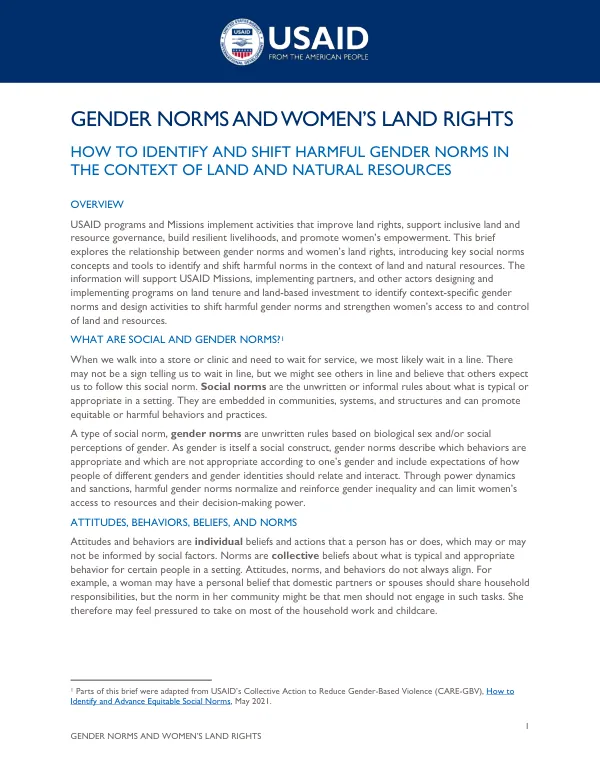
GENDER NORMS AND WOMEN'S LAND RIGHTS The relationship between gender norms and women's land rights is a critical aspect of USAID programs and Missions.
2021 · 5 pages
Sign in to readA free account is required to download.
Abstract
These programs aim to improve land rights, support inclusive land and resource governance, build resilient livelihoods, and promote women's empowerment. The brief explores the connection between gender norms and women's land rights, introducing key social norms concepts and tools to identify and shift harmful norms in the context of land and natural resources. Social norms are unwritten or informal rules about what is typical or appropriate in a setting. They are embedded in communities, systems, and structures and can promote equitable or harmful behaviors and practices. Gender norms, a type of social norm, are unwritten rules based on biological sex and/or social perceptions of gender. These norms describe which behaviors are appropriate and which are not, according to one's gender and include expectations of how people of different genders and gender identities should relate and interact. Attitudes, behaviors, and beliefs are individual beliefs and actions that a person has or does, which may or may not be informed by social factors. Norms are collective beliefs about what is typical and appropriate behavior for certain people in a setting. Attitudes, norms, and behaviors do not always align. For example, a woman may have a personal belief that domestic partners or spouses should share household responsibilities, but the norm in her community might be that men should not engage in such tasks. Several tools have been developed to support program implementers to identify social and gender norms, design norms-shifting activities, and monitor shifts in norms. These tools include the USAID-funded Passages Project and the ALIGN (Advancing Learning and Innovation on Gender Norms) Platform. The process to identify gender norms involves several steps, including analyzing information, applying findings to inform programming, and monitoring shifts in norms. Owning land is a powerful pathway to improving economic opportunity and livelihoods, fostering dignity and improved wellbeing, and building self-reliance in developing countries. Although women play a critical role in food production, they are less likely than men to own, inherit, and control land and natural resources, which limits their socioeconomic empowerment and increases their vulnerability to gender-based violence. Inequality in the ownership, access, use, and control of land and natural resources is caused by multiple factors, including discriminatory legal and policy frameworks, male-dominated governance systems, unequal access to education and information, and harmful gender norms related to men's and women's public and private roles. USAID Land and Resource Governance division (LRG) land projects, such as Integrated Land and Resource Governance (ILRG) and Communications, Evidence and Learning (CEL), are using the concepts and frameworks described above to implement activities to shift harmful gender norms across countries at different levels and with different actors. A future brief will discuss the main gender norms related to land, natural resources, and agricultural value chains, as well as the gender norms-shifting approaches used, results, challenges, and lessons learned. The list below provides resources for programs in the land and natural resource sector to better understand gender norms and to navigate the process to identify gender norms, design and implement norms-shifting activities, and monitor shifts. These resources include USAID's Collective Action to Reduce Gender-Based Violence (CARE-GBV), the Institute for Reproductive Health, Georgetown University's Social Norms Atlas, and the Advancing Learning and Innovation on Gender Norms (ALIGN) Platform.