USAID. MISSION TO MOROCCO
Renewable energy development
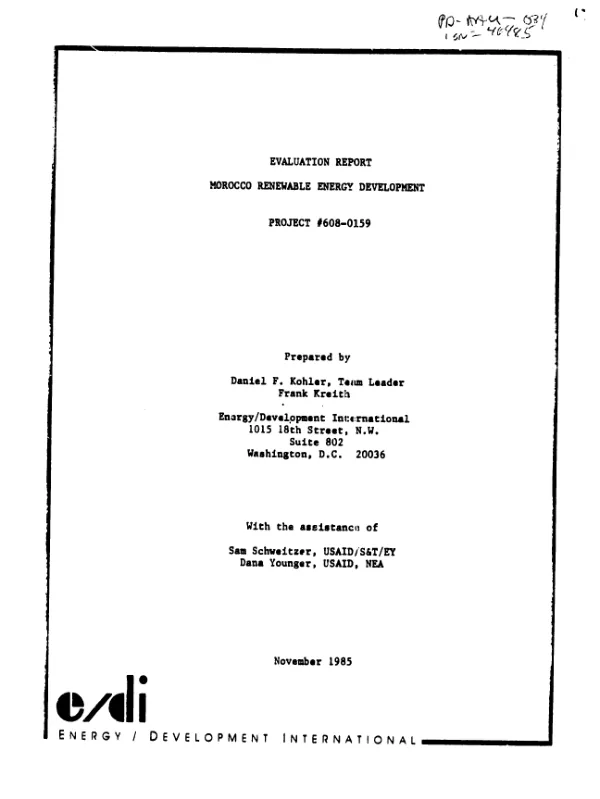
Summarizes attached mid-term evaluation (PD-AAU-034) of a project to promote renewable energy (RE) development in Morocco, especially by creating a Center for RE Development (CDER).
1985
Sign in to readA free account is required to download.
Abstract
Evaluation covered the project"s first 3 years. The CDER has been created and is operating as well as could be expected. However, only 2 of the 9 targeted RE pilot projects are in operation. These projects have consumed a large percentage of the project"s financial and human resources and have done little to encourage the human capital transfers and the institution building intended by the overall project. Originally intended to provide hands-on experience to CDER staff, the pilot projects were assigned a much broader role in a Project Paper amendment, a development which has reinforced an already heavily technology-dependent approach to RE development. What is needed is a systems-oriented approach encompassing not only engineering, but economic, social, and financial aspects as well. A feasible solution would be for CDER to pursue in-country commercial applications of new technologies, using the private sector as their source of distribution. In addition, the project"s training component has lagged. CDER was not fully staffed until a year and a half ago and so could not have utilized a training program properly. Still, once the staff was completed, training should have been pursued more vigorously. The TA provided by Research Triangle Institute (RTI) and a subcontractor, A.T. Kearney, has been good to excellent in some technical areas such as wind and micro-hydro, but virtually non-existent in systems analysis, economics, and policy analysis - areas critical to further development of RE technology. CDER"s Small Projects Fund could be of use here in arousing private sector investment. While not yet operational, it does appear to be on the right track. Principal recommendations are that: (1) CDER develop a goal-oriented plan for its activities (existing plans are inadequate) and strengthen its analytical capabilities by providing its staff with additional training and/or by hiring professionals in systems analysis, economics, finance, etc.; (2) the Project Assistance Completion Date be extended conditionally to allow time for focusing of activities; (3) USAID/M monitor the project more carefully and assert some quality control by forming a monitoring committee or technical advisory board; (4) new pilot projects be evaluated on the basis not of the energy they produce, but of the information and training opportunities they provide; and (5) CDER/RTI/A.T. Kearney use professional peer review to improve the quality of their reports.
Related documents