USAID. MISSION TO MOROCCO
Renewable energy development, evaluation of phase I
Evaluates project to stimulate the development of renewable energy resources in Morocco.
1982
Sign in to readA free account is required to download.
Abstract
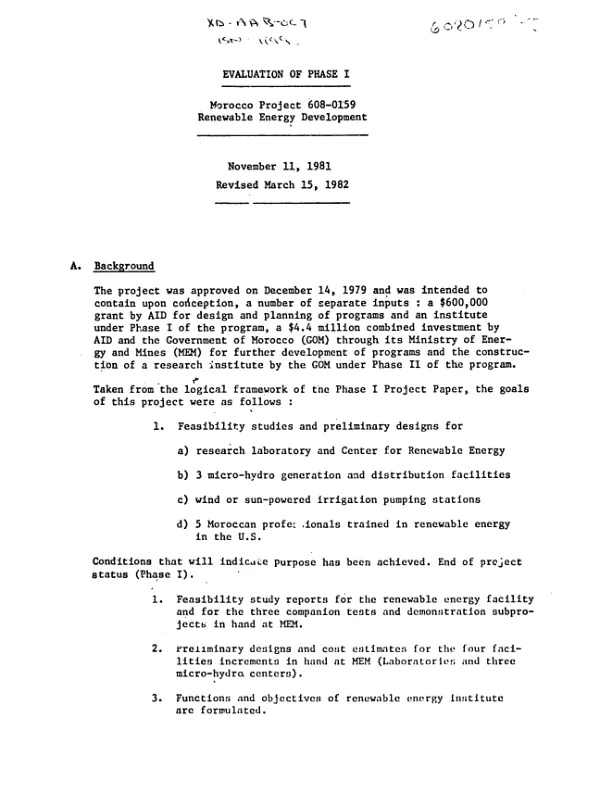
Special evaluation covers the period 11/79-11/81 and is based on document review and interviews with USAID/M and Moroccan project personnel. Progress was hampered by a conflict between USAID/M and AID/W over project focus, the former emphasizing the project's research and development role and the latter viewing the project as a financially viable commercial investment. Planned project outputs have been only partially achieved. U.S. training in renewable energy was provided to six engineers; U.S. training for four other engineers is underway. Engineers and other staff also received English lessons. The director of the Center for the Development of Renewable Energies (CDER) and his assistant received preparation for U.S. training. Four feasibility and preliminary design studies for three small hydroelectric systems were completed. Several preliminary schematic designs for a CDER headquarters in Marrakech were completed; construction is to start in the spring of 1982. A study and preliminary design of wind/solar irrigation pumping stations were also completed. Primary problems which have constrained project progress include administrative and bureaucratic delays within the Ministry of Energy and Mines (MEM); USAID/M's inexperience in executing a project of this nature; communication failures between the MEM and A.I.D.; lack of continuous project monitoring; MEM and A.I.D. staff changes; and A.I.D.'s insistence on contracting with one firm for all services, despite the firm's lack of experience in some areas. External factors which affected implementation include the MEM's lack of leadership due to its total dependence on A.I.D. for funds, weak logistical support within the MEM, and delays in establishing the CDER's institutional autonomy. To improve project performance, it is recommended that USAID/M: coordinate schedules between A.I.D. and the MEM; provide more technical assistance in the execution of project studies; determine the level of technical assistance needed for project completion; and develop evaluation criteria based on verifiable indicators. In addition, A.I.D. should follow USAID/M's advice to avoid inadequate contracting.
Related documents